What We Want, and How we are Going to get it.

12 Dec

 What We Want, and How we are Going to get it.

The Boston Anti-Authoritarian Movement Newsletter, Issue # 25 – September 2009


The most common and valid criticism of anarchism is that it appears to lack a concrete and cohesive vision for the future. This criticism is valid, not because such a vision doesn’t exist, but because the modern anarchist movement has thus far failed to present it in a comprehensive way, simple enough to be widely understood and accepted, and penetrating enough to be endorsed by the majority of anarchists and like-minded people. Most of our writings that best achieve this are a hundred years old, and the language, though easily understood in that time, reads like Shakespeare to us today. Below is one attempt at such an introductory description of anarchism in today’s language.


What We Want

Anarchists strive for a society of freedom and equality for all. Of course, we must define these terms, as they are twisted and misused every day by politicians and other opportunists.

By freedom, we mean both political and social freedom. Communities and individuals must have the freedom to participate in all of the decisions, laws, and agreements that affect them. Anything short of this is at best a false democracy. Decisions should be made in public meetings and popular assemblies, using Direct Democracy, so that everyone has an equal voice. This way, communities free themselves from the oppression and illegitimate authority of government, who today make all of the decisions for us. The antithesis of political freedom is government, which has and always will be a tool of domination of a privileged minority over the rest of us. We aim to replace this ancient foundation of inequality with a grassroots network of autonomous, self-governing communities, unions, federations, and other associations.

The foundation of true freedom is mutual respect. We must have freedom of thought and desire, the freedom to love, to think, and to act. So long as our actions do not impede the freedom or well-being of others, our freedom will be anarchy. No individual is truly free without a supportive and open-minded community, and no community is ever free if it is not made of truly liberated individuals. Moreover, no one is truly free until everyone is free. We believe in freedom of women, queers, transgender people, people of color, immigrants, workers, and all others traditionally oppressed by the current order. Most importantly, we support their freedom to resist this oppression and to fight for their own freedom and equality.

Freedom founded on respect and solidarity, is what we define as anarchy. Freedom is an easy concept to grasp. We feel it burning in our guts. We know it is stifled and repressed by our current society, regardless of how free our politicians and bosses say we are.

By equality, we mean economic equality. By this we do not mean that everyone must be exactly alike or posses exactly the same things. We mean no human should be dominated by or have authority over another. To achieve economic equality is to eliminate class distinctions. Today, because there are two classes (and sometimes a middle class buffer) one massive class suffers the terrible struggle of poverty so that the other tiny class can live in leisure and luxury. This is how capitalism works.

Our economic motto is “Production by each according to their ability, and distribution to each according to their need.” Humanity produces far more than enough to provide for everyone. If our societies were to share (as an economic model) instead of hoarding greedily, if we were to hold all that we produced as common property within our communities, then we would completely eradicate poverty, homelessness, and hunger. Human society organized on such a model would naturally produce to meet the needs of the people within the society. People would work harder when there’s a shortage, trade and give to other communities when there is abundance, and share the leisure and creativity, bi-products of efficient productivity. Communities built on freedom and equality take care of their own.

We who work make everything, so we know the obstacle to economic equality isn’t our inability to produce enough for everyone. To realize this, we only have to look at the massive factories, the bountiful fields of crops, and our ever-advancing technologies, and then at the heaping mounds of food and clothes rotting in dumpsters, and at abandoned buildings and factories crumbling to the ground. The problem is our system of distribution and ownership, that is, capitalism, which is the antithesis of economic equality.

In capitalism, those who own – the factories, tools, means of transportation, hospitals, schools, and apartments – make an enormous profit off the rest of us. We work the machines, rent the homes, pay for transit to and from work, pay to buy food and feed our families, but then lose more money to terrible insurance companies and taxes paid to our useless government. We are the vast majority of humanity, but those that own do nothing else except accumulate wealth, which they use to buy more.

If everyone had their needs met, there would be no profit for those who owned. We wouldn’t pay them to be useless and lazy if we produced to meet our needs and shared. Thus, those that own also waste. Restaurants throw out food at the end of the day. Landlords keep apartments empty. Bosses keep their businesses understaffed. Developers keep plots vacant. All of this they do to create an artificial need for their ownership. In reality, we do not need bosses to own our time and lords to own the land. We need only to create and share.

We aim to abolish capitalism and all other economic models where people accumulate wealth and property to achieve leisure and power, or where money determines the value of anything important. We believe that there should be no private ownership, in that no individual should be allowed to hoard more than they need for their own private use. Likewise, no individual should be allowed to go hungry or homeless. Nearly every human contributes to society in some way or another, and thus, membership in human society should bring with it the guarantee of access to the necessities of life. The bulk of what we produce, things of necessity and leisure alike, should be brought to markets and storehouses both common and free, or otherwise freely shared between neighbors, coworkers, communities, industries, cities, and regions. In this way food, clothes, housing, and the tools of production should be available to all. In other words, we believe in economic communism or socialism, not the bastardized systems of government created by opportunists speaking wrongfully in those names to reproduce the inequality and repression of capitalism, monarchism, and other forms of governmental dominance. We mean socialism, or communism, in their original meanings, which we have described above.

So to recap: we fight for anarchy, a highly-organized political system of self-governing communities free of hierarchy and all forms of oppression, and for socialism, an economic model based on equality and sharing, as opposed to ownership, exploitation, and profit.


How we are going to get it.


Surely, some of those reading this are wondering how humans—who appear to be such a selfish breed—would care to work to provide enough for all instead of accumulating only for themselves and their closest loved ones. However, humans behave how they are socialized, and whole societies have, do, and will continue to live in ways drastically different than our hyper-competitive capitalist American nightmare. The best way for human society to survive has always been for everyone to work together, for the good of all. Even in our capitalist world, signs of this alternative are all around us. Societies, both human and animal, that cooperate instead of compete, ensure the highest quality of life for themselves.

People revolt when they learn of their domination by the rich class, sometimes in small ways and sometimes on a society-wide level. People learn better ways to live and they attempt to bring them to life. However, most revolutions humans have made so far have only replaced the old systems of inequality and exploitation with new ones. They didn’t win both freedom and equality, and one without the other creates neither. Most anarchist revolutions have been sabotaged by anarchists’ allies—generally, state-supporting communists—who in practice believed in equality and not freedom, as in the Ukraine and Spain.

Anarchy cannot exist anywhere unless the vast majority of people living there want it, because only they can create and maintain such a decentralized, organized system. This is why the first step to anarchy is educating and agitating for social revolution.

Social Revolution occurs first in the minds and spirits of revolutionary people, and then casts itself upon the physical landscapes of human habitats. To get to this point, anarchists need a massive education campaign. We need schools for raising free children, for teaching adults useful things, and for educating about successful struggle and political ideas. We need a vibrant community of thought, action, arts, music, traditions, and celebration that can become more powerful than the mother culture of capitalism. We need publications, plays, films, public art, and widespread propaganda for freedom and equality.

First, anarchists need to participate positively in the struggles occurring around us daily, not only as anarchists, but as neighbors, fellow workers, peers, lovers, and comrades. We need to participate in existing social change groups and create new ones where needed. These are the future associations of direct democracy, because they are the organized, active populace trying to create a better society today. We need to connect them to each other by pointing out common struggles and by organizing popular assemblies.

We need strong, well-organized anarchist groups, dedicated to the social revolution. We need to network, federate, and confederate our existing anarchist groups internationally, regionally, and locally, and through them build public programs, publications, festivals, campaigns, and more. These organizations exist today, but they must grow and become better connected. Improved communication and resource sharing will give anarchist groups needed support when they stand on the threshold of revolution, or when they face repression from the state. We will teach each other the vital skills needed to win revolutions and we will practice them.

Through our organizations, networks, and propaganda, we will agitate for social revolution, and participate in struggles that challenge the divide between oppressor and oppressed, always standing with the oppressed against the oppressor.

Physical Revolution occurs when the people seize the landscape of their communities and implement freedom and equality. This can theoretically occur gradually, but usually it comes from an explosion of social action. Workers seize their workshops and work for their communities instead of their bosses. Neighbors drive the landlords out and govern themselves, ignoring or expelling politicians. In the space created by these actions, the oppressed of all sorts stand up to their oppressors, and through their actions, make freedom and equality.

Anarchist groups may help in creating the conditions and social mindset for revolution, and when the people at large create the revolution, by accident, in reaction to some cataclysmic event, or by planned uprising, anarchist organizations must be prepared to help our neighbors take and operate the mass media to promote our ideas, occupy our jobs, and barricade our streets. We must call for popular assemblies, create moneyless markets, public storerooms, and other means of sharing. We must immediately make sure that the hungry are fed and the sick and wounded are cared for. We must tirelessly promote complete freedom and equality for all, and quickly organize the defense of our social gains.

We need to seize armories and arm the people, because those with power defend their power by force. We need volunteer militias and barricade networks to defend liberated territories from the police and the militaries of the state and their allies. Ideally, we will have infiltrated the military beforehand, or win large portions of the army over in some other way, as soldiers are workers, too, generally from working class communities. Militias and organizations may have to form larger volunteer columns of fighting people to win a war against the government. Because we will be out-gunned, our fighting tactics must rely on highly-mobile volunteer forces with superior knowledge of the territory, using the element of surprise, opportunistic ingenuity, and trickery at every turn. Fighting conventionally, we will lose, so we will have to be creative.

Theoretically, we would plan and launch simultaneous revolutions across the world, but this is unlikely. Regardless, our international organizations must be strong enough to participate forcefully and effectively to support those fighting for freedom and equality. We must flood revolutionary places with international volunteers (for fighting, cooking, healing, and all sorts of other vital support roles), supplies, weapons, money, ideas, and more. Our international allies should attack the mechanisms of the state’s war effort, stopping shipments and production of weapons. Our international organizations will help spread the Empire thin by engaging its forces and its allies with their own campaigns and actions.

If we succeed in creating a revolution in the United States, and in particular on the East Coast, the world will have a fighting chance at global revolution. By decapitating the head of the beast, we will create space for those occupied by the most sophisticated empire in the history of the world to rise up for their freedom, which in turn will help us to win here. Global freedom and equality will only come from a concerted, international effort to re-organize society with revolution, and a willingness to support such revolutions wherever they occur.

The American Dream and the Anarchist Dream

11 Dec

The American Dream and the Anarchist Dream
The Boston Anti-Authoritarian Movement Newsletter, Issue # 20 – April 2009

Throughout the years, much has been written about the American Dream. We learn from our schools, our families, the churches, and the media that to achieve this dream—namely to own a home, to gain material wealth and the freedom to buy, to have both leisure and convenience —is to achieve happiness. In a word, the American Dream is to prosper, to carve out a life of prosperity for you and yours in a highly competitive society.
For millions of Americans, this dream is slipping away. The American Dream is being replaced by the stark reality of American Life: a constant struggle to survive capitalism, to have food on the table and a roof to sleep under. People are increasingly realizing that the American Dream is unattainable. This realization comes from the recent and obvious failure of the capitalist system, represented by the global economic collapse, and ensuing depression that grips us all by the stomach and the throat.
Except for a small minority of people, the American Dream has never been and could never be more than a dream. Most people will never achieve the American Dream because it’s nothing more than climbing to the top of the capitalist system; and not everyone can climb to the top of a pile of climbers. To maintain the American Dream is to condemn the vast majority of people to a lifetime of thankless toil, to produce for the privileged few their celebrated spoils of leisure and convenience. Without the sweat of the working class, there is no American Dream. Thus, the American Dream is not only a false dream for all but the privileged few, it is also a selfish dream, because its realization for anyone dooms the rest of human society to economic slavery.
The myth of the attainability of the American Dream is perpetuated by those who have achieved it, to keep the rest of us working hard to produce the wealth, leisure, and convenience they enjoy.
So let us, then, explore another dream: the Anarchist Dream. Springing forth from the very nature of humanity, a vision of society as old as society itself, it was given a name (Anarchism) late in the process of departmentalization and segregation of civilization into a system of classes, castes, and nation-states. The assignation of a name marked the birth of a movement against the slavery and bondage to which the majority of us are subjected. Our masters consider the Anarchist Dream a dangerous dream indeed. These masters, those leeches who enjoy the benefits of the American Dream by sustaining our nightmare, call it dangerous, foolish, and unattainable. In a way, these condemnations are true.
The Anarchist Dream is dangerous—to the rich parasites that live lavishly off of our grief! The Anarchist Dream is a vision for a new, free world, a society where all humans live in equality, where the things we build and grow, and the things that Mother Earth provides her children, are not to be hoarded by the selfish and violent few—bosses, governments, corporations—but to be shared by all. In such a free world, nations and governments will be replaced by the free associations of communities, villages, and neighborhoods, to organize and self-govern as they see fit. The bosses that hold our time and our stomachs hostage will be replaced, but only by us, the workers, organized together in non-hierarchal collectives, unions, and associations as we see fit. So that we may share the products of our labor among ourselves and with our communities. So that we may create that which we, as human societies, need, instead of just that which will make our bosses the most profit. So that we may create on the principle of “from each according to ability, to each according to need.” So that we may eliminate the useless jobs, the banks, insurance agencies, and greedy corporations who got us into this mess of poverty in the first place, and re-organize the vital jobs in an egalitarian manner. So that we can carry out our labor without carelessly destroying the earth, without which humanity, like all other living things, is doomed to a dull and lonely existence on the road to extinction.
The Anarchist Dream is dangerous—for the rich—because in this beautiful dream there are no rich. There are no rich, and there are no poor to make the rich the rich. There are no poor, there are no homeless, and there are no hungry. For where there are people with hands, brains, skills, and talents, we can create. And where humans can create, we can produce, gather, and distribute vast quantities of all the necessities, more than enough for us to all live good lives. And when we are free, there’s no reason not to share. Just look at the things we’ve already created! Vast cities of skyscrapers, incredible laborsaving technology, and inspiring environmentally sustainable methods of producing energy, food, and everything else. All of these and more are the accomplishments of an enslaved humanity. Imagine what we can do together once we are free, once we are inventing, not for the profit of corporate bosses, not for the dominance of this government or that military, but to dream up, invent, produce, and create for a life of enjoyment for our communities.
The Anarchist Dream is dangerous for the rich because the rich cannot control workers infected by it. They cannot dominate societies that fill their cups to the brim and boil over with the revolutionary spirit. They cannot divide and conquer a people who recognize each other as siblings, siblings for whom life, liberty, health, and fate are infinitely intertwined and interconnected. Siblings, without each other we are nothing, but together, we are unstoppable.
The Anarchist Dream is foolish and unattainable—according to the leeches and parasites—because it can never happen. Except it has happened: in short breaths of life in Greece in December of 2008; in Oaxaca, Mexico in the summer and fall of 2006; in the neighborhoods, factories, hotels, restaurants, and other recovered workplaces in Argentina, 2001-2002; rising from the Kabylie region and spreading across Algeria throughout 2001; in much of Spain from 1936-1939; in southern Ukraine from 1918-1922; in the countless revolts and revolutions of peasants and workers throughout the middle ages; and for all of human history before the class of parasites was able to establish its dominance over free societies by hoarding food and land with violence and treachery.
The Anarchist Dream, rather, is foolish and unattainable—according to our masters—because if or when we try it, they will throw all of their resources at us—their guns, their armies, their bombs, their tanks, their jets, their missiles—as they have every other time we’ve tried it, and they will destroy us. They will destroy us to kill the ideas in our hearts, to kill the examples of a new world we build by our being, acting, creating, and organizing. They will do everything they can to wipe us clean out of existence so that our bad example—bad for them—cannot spread to others, to be planted like the seeds of hardy weeds, or the particles of an infectious virus, to engulf all of society like a forest fire and make life unbearable for the parasites, to burn them out! But they cannot kill us all. Oh, how they’ve tried! Each time, the Idea, the Dream escapes their slippery, sweaty fingers and resurfaces again. They will never kill the Idea, the Dream, nor the rebellious nature of the hardy weeds, constantly trampled underfoot, but always refusing to stay down. They cannot win forever, and we will never stop trying, stop fighting, stop rising up. Our day, our Idea, our Dream will come in time. It will pour out of the earth like a vibrant forest; but just like a forest this growth will take time, and right now we’re just hardy weeds with powerful dreams germinating the soils.
We, foolish dreamers and romantics who profess the Anarchist Dream, will never give up, for we know another thing they wish we’d forget: while their dream, the American Dream, is obtainable only by they, the privileged few, our dream includes everybody—even them, if they’re willing to abdicate their thrones and toss their paper crowns aside. Anarchism, by name, nature, idea, and practice, promises freedom and equality to everybody. This is a far cry from the misplaced dream of the toiling, slaving millions, dreaming only to stand in the place of their oppressors: to be their own masters.
So give up the American Dream, for it can never be yours. Even if it is yours already, it comes at the expense of the rest of humanity, that strong and rebellious breed who will shun you and fight you for freedom until the last breath and the final ounce of blood. Embrace, instead, the Anarchist Dream, the beautiful vision of an liberated humanity, where we are all free to dream, and where the collective creativity of emancipated thought and labor will turn the brightest of dreams into vivid realities. Defect, siblings, to the revolution, that righteous insurrection of dreamers.

Remembering the Angelica Strike

10 Dec

In remembrance of the victorious strike that began three years ago today.

Angelica Workers Win Strike

The Boston Anti-Authoritarian Movement Newsletter, Issue # 29 – January 2010

After a five day strike beginning on December 10, 2009, the largely immigrant workforce of Angelica Textile Services in Somerville won a new contract with benefits and higher wages. Angelica, a billion dollar company with over five thousand workers nationally, counting on its board the likes of Jeb Bush (George’s brother and former Governor of Florida) had stalled negotiations with the Somerville workers. The workers, members of the United Food and Commercial Workers Union Local 1445, were asking for a one dollar wage increase, more company contribution to the healthcare plan, and an extra dime an hour for the pension plan. They voted to strike on December 1. As Local 1445 representative Fernando Lemus told the Boston Globe, they were willing to “sacrifice this Christmas” because “the cost of living is so high.”

Five days later, the company offered a new contract. Hundreds of workers and supporters from other unions and Centro Presente (an immigrant workers center across the street from Angelica) had maintained picket lines from 6 A.M. until midnight. The workers voted to sign the contract, ending their strike and declaring victory. Supporting unions, according to the Party for Socialism and Liberation, included: “the International Union of Painters and Allied Trades District Council 35; the International Brotherhood of Operating Engineers, Local 877 Area Trades Council; the International Brotherhood of Electrical Workers, Local 2222; the American Federation of Government Employees; Unite Here, Local 26; and the Teamsters, Local 25.” Along with the outpouring of support, Local 1445’s impressive unity and resistance to the bosses’ attempts to divide them contributed to the overwhelming victory.


From “Nine Years of Anarchist Agitation: The History of the Boston Anti-Authoritarian Movement and Other Essays” by Jake Carman

An article a day!

9 Dec

Hey all,

I’m going to publish on this blog one article from my new book a day for the next 12 days, as a countdown to the release party. Sign up to follow my blog to get the articles emailed to you!   Follow

To start it off, and as a late celebration of December 6th, the anniversary of the 2008 Greek Insurrection, here’s an interview I did with Athens members of the Greek Anti-Authoritarian Movement.

Violence is a Small River, To be with Society is an Ocean: An Interview with Athens Anti-Authoritarian Movement Comrades, August 2010, in Exarcheia, Greece.
The Defenestrator, Issue # 50 – December 2010

This August I interviewed three comrades from the Athens section of the Anti-Authoritarian Movement of Greece (Alpha Kappa/AK in the Greek acronym). The folks I interviewed live in Exarcheia, a neighborhood with a largely anarchist population in central Athens where the December 2008 Greek Uprising began, and around which two hundred police maintain a permanent security perimeter. AK, the largest anarchist organization in the country, is based around only three points of unity. These minimum core values are:

-The anti-authoritarian character of its scope and frame.

-The direct democracy in the way of decision-making.

-The denial of occupation of any form of power.

Vaggelis Nanos is in his early thirties. He helped found Nosotros, the first and largest social center in Exarcheia. He also works on Babylonia, AK’s monthly publication which is distributed in kiosks across the country. Sofia is also in her early thirties, and is a member of the AK working group for the creation of an anti-authoritarian economy. Epaminontas “Nontas” Skiftoulis joined the movement when it first began its struggle against the Military Junta in the early 1970s. He is quite influential for his ideas and articulateness. Police also accused him of being a member of an early anarchist guerrilla group.

What have anarchists in Greece done well that United States anarchists might learn from?

Vaggelis, as a proud founding member of Nosotros, insisted that Social Centers are an integral part of successful modern anarchist movements. His argument, which included tours of some spectacular spaces, was quite convincing. “In 2005,” Vaggelis began, “we started Nosotros. It was the first time we thought about social centers. What remains from the December 2008 uprising is that we have many social centers, which are some of the best things anarchists have made here. Some of these are occupied, some are rented. Some are for winter, some for summer, like the self-organized park Navarinou.” Nosotros, like the other social centers we saw, is a large building with classrooms, computer rooms, libraries, offices, child-care centers, film and music spaces, and invariably an indoor bar for winter and an outdoor bar for summer. Navarinou in Exarcheia is a rare place: a park in the concrete landscape of Athens. Once a parking lot, the people of the neighborhood tore up the pavement, put in soil, built a playground, planted trees and bushes, and built a stage with some seats for discussions, music, and film screenings. Thus they created an autonomous park in a city sorely lacking in parks.

Vaggelis described the essential part that Greece’s social centers play in the struggle: “Firstly, they are spaces for meetings. Secondly, the free spaces are run by assemblies. So it’s an experiment to see if we can run spaces completely with no leaders. So far, it’s working. At Nosotros, we have lessons for immigrants and students, lessons in instruments, and more. If you know something, here you can teach it to others. The social centers are also the point from which we start to organize resistance to everything. When there is a problem in the neighborhood, we go there.”

What mistakes have the Greek anarchists made that we in the U.S. may learn from?

Sofia told of an act that happened as the Greek Parliament was voting for the IMF bail-out: “On the 5th of May, 2010, there was a huge manifestation. People said they hadn’t seen one so big since the first years of the dictatorship. During the manifestation, some people burnt down a bank. Three people who were trapped inside were killed. It hasn’t been proven that those who torched the banks were anarchists, but most likely they call themselves anarchists. That morning, society had welcomed anarchist ideas. Afterward, we had to apologize for an incident committed by about three people whom we feel acted against all those who participated in the demonstration. Maybe somewhere it’s written that anarchists should burn banks, but we have to think about what’s good in a certain situation.”

“Similarly,” she continued, “after December 2008, the movement was still going on, but a guerrilla anarchist group shot at policemen in Exarcheia. Three hundred police were hurt during December, and people were fighting alongside us almost every day in the streets. But one shot against one cop turned the people against the movement again. We took a step backwards.”

“There are many big mistakes, so what?” Vaggelis said. “But the idea that we know the truth is our biggest mistake. Most anarchists believe we know the truth and the people don’t, so the people must follow us. For example, there was a park called the Self-Organized Park of Cyprus and Paticion. The people occupied the park and self-organized. Anarchists went there and said, “this isn’t anarchist enough. We can’t sell beer. We can’t have this concert because the singer isn’t anarchist.” So in two month’s time, the only people who went there were anarchists. Many times we prefer pure anarchy than to have a relationship with society. This is a mistake. Like Marxism and Stalinism, if you believe completely in it and don’t allow criticism, we are no better than them. We go straight to one closed system.”

When Nicholas Stylopoulos (also from AK and Babylonia)came through Boston to speak, he explained that Greek anarchists had the power on the streets, and that “If we had two hundred thousand people, we’d overthrow the government, but then what? That’s the problem…we don’t have a message. People on the street want a plan.”

“Yes, we are very good fighters,” Vaggelis said, “but we don’t have the ways to run society. We have no structure to offer. The truth is, if we want to have these structures we must build them with society, which knows how to produce, how to distribute the things she needs. Together we must plan the society we all want. We can’t isolate ourselves. After December, many of us can see this problem. Maybe lectures are something society needs, but how are we going to take the products of the countryside to the city? We haven’t found out yet how things will be after the revolution. How will we decide what kind and how much energy to use—gas, sun, solar, nuclear?”

“The point is, we need to build more movements. If we have a big Eco movement, and another one of people from neighborhoods, the two together can decide what energy to use. If we have a strong farmers’ movement, we can build horizontal farms to produce and share with cities. Some of these farms exist, and sell to Nosotros and other social spaces, but we don’t know how to do this on a larger scale. There are four million people in Athens, three million between the three other big cities, and only three million in the countryside. Only one thousand are farmers, and only one hundred are anarchist farmers. So how do we feed the cities?”

“We’ve thought of problems we’ll have after the revolution, but we can’t predict what will happen. Marx said Russia can’t have a revolution, it’s only farmers. He said only Germany can. Germany had the Nazis, and Russia had the revolution! How will we run schools, and technology? Do we need these or not? Revolution is full of problems. But from the other side, this is nice about revolution: together we figure this out.”

“First, we need experiments. Alternative schools, farms that have direct relationships with the city. If these work, then more people will do it that way. One day the revolution will come, and we won’t even notice it. We must get to the point where both sides have no other choice. We are far from this.”

Responding to my question about whether the solutions of classical anarchists have been useful, Vaggelis said, “Authority nowadays is more complicated than it used to be. We have to win many more fights, be equal with women, gays, the environment. In 1900, Kropotkin said, “The machines will save us.” Today we say, “The machines will pollute too much,” so we can’t just trust these dead guys. They’re too old. I love them, but we can’t trust them. For instance, nobody today says “I’m a worker.” We have one hundred hobbies. We can’t say, “We’ll go to a union and have a revolution.” We don’t all care about our jobs. Work is important. We spend more than eight hours a day there. But there’s more, too.”

How are Greek anarchists addressing these obstacles?

Sofia suggested, “Greek anarchists must overcome ideology, to learn to be with society and live within it, not outside it. That’s what we’ve tried to do here in Exarcheia. After December 2008, people, not only anarchists, occupied public spaces and tried to manage these places using direct democracy. Also, here there are many anarchists who are open minded and try to build structures, and there are others who are not. I can’t speak of anarchists as a unified thing.”

As for Alpha Kappa, Sofia continued, “At the May conference we concluded that we want to work on a project of an anti-authoritarian economy, exploring the values and the key issues and the applications it can have. That’s why a new work group has been formed. It meets once per month. So far we’ve agreed on some main principles that such an economical system should be based on: justice, autonomy, ecological harmony, diversity. We have studied several alternative economical systems proposed by Albert, Fotopoulos, and Latouche (degrowth), in order to identify their proposals according to some main issues such as property, labour, and decision making inside such an economic system. We agreed to present every month the progress of the meeting in an article published in Babylonia and in an open discussion at Nosotros.” At AK’s Festival of Direct Democracy, held in Thessaloniki in September, the entire second day, called “Exodus from Capitalism,” will focus on the anti-authoritarian economy. As Sofia said, the research process “will last at least one year and hopefully we will have some fruitful results.”

Vaggelis added, “I think now we are starting to try to build these structures, both in Alpha Kappa and in other organizations, but we are at the beginning. We have bookstores, bars, restaurants that work collectively, but too few. We must do this much more to see if this experiment will work.”

How can United States anarchists help the Greek anarchist movement?

Nontas, sitting outside one such anarchist bar, said, “You are helpful in many ways, but you don’t know it yet. At this moment, in order for Greek society to operate again, we need an alternative solution. Because of the rotting state, which can’t give society solutions, the economy doesn’t work anymore. Society’s institutions have been destroyed, like families, education, etc. We are living without meaning, living for ourselves and not a community.”

“We need a solution that’s not ideological, not theological, not messianic, but a direct, logical, rational solution….That’s why we study and invite to our festivals American intellectual radicals. For example, we have used Michael Albert’s book Parecon in our analysis of farmers, small cooperatives, and buyers, as against the middle man. Another example, we used (David) Graeber’s suggestion of substituting the language of anarchism with direct democracy when speaking with society. So when the prisoners revolt we don’t impose our ideas about imprisonment, but instead hold assemblies and together discuss the demands such a movement can pose.

“You in the US can further help us with protests outside travel agencies and by sending us reports about solidarity actions. You can do a lot for Greece. Now is the right time because the Greek people are waiting to hear from other countries.”

As for the present, Vaggelis says, “what we can do for each other is to have actions. When in December you did actions for us we felt we are not alone, so we must go on! The same we can do for you. This is a nice thing.” Money from the resource-rich United States, Vaggelis said, is not necessary nor desired from Greek comrades. “When we had a little social center, we couldn’t pay the rent. Then we said ‘we’ll rent this bigger building, $2000 Euros a month plus $1500 to fix it.’ We found the money in one month, because we believed in that project. We don’t need anything else. We don’t want your bloody dollars,” he laughed.

How might Greek Anarchists help U.S. Anarchists?

Vaggelis began by suggesting (jokingly?) that Greek anarchists pay for social centers in the United States. Then Vaggelis, who is by no means a pacifist and frequently delighted in showing us Youtube videos of Greek anarchists fighting police, said, “We only do bad things for anarchists elsewhere. People in the United States are starting to believe that fighting is more important than ideas and organizing. Fighting is important, but really the ideas are more important. To have the streets is important, but to do that you must glue the streets with posters, to give the people your papers, and to explain to them what you believe. The last step is fighting the cops. You need all of that—the ideas, the effort, the organizing—to win the streets, not just the stones. It’s psychologically easy to fight the cops. You just throw stones, then run away. It’s easy to be a macho guy, but you can beat the baby, or you can teach it.”

“We must sometimes have violence, but our purpose is not just to have the fight. In ’95, the Polytechnic school was occupied for three days, so we were fighting the cops. Five hundred people were arrested. After that it took many years to have a demonstration with a lot of people. Fights can do some things, but they can just as easily undo things. As we say, its like an umbrella: if it’s raining, you take it. If not, you leave it at home!”

Nontas spoke similarly: “Here in Greece, the purity of action and activism, the romanticism of the action prevents the reflection and digestion of what we have done until now. Our youngest anarchists have already thrown one billion stones, built one hundred bombs, and fought the police. Today we have thirty anarchists in prison. There are thousands who have gone to prison. We don’t only need people to throw stones, we need people to talk to society so they can understand and accept what we propose. We need to be specific about what we propose or else they say ‘Bullshit!’ to us. When you can relate to society, you have escaped the activism plague.”

“Everything is starting with the thought. Violence is a small river, to be with society is an ocean. Anarchy is a great, open road. We can’t close it. We must discover it little by little by working.”

Sofia concluded, “What we need to do is to use our imagination and overcome what is posed to us by the status quo and build structures that are based on principles other than those that are imposed on us. For instance, instead of capital being the major purpose, human dignity and nature should be taken into account.”

“So whether we manage to build such structures or you do, it will help all the others because in doing so we will have discovered the path. So what we all have to do is to try to build the structures not only globally, but try to apply these principles locally like an experiment. I think these experiments can occur even now inside capitalism, and if they prove to be successful, then we can apply them on a larger scale.”

Image

Book Release Party

6 Dec

Book Release Party

Here’s the flier. Tell your friends!

Book Release Party!

6 Dec

Friday, December 21st, 2012, 6-8pm
Book Release Party!
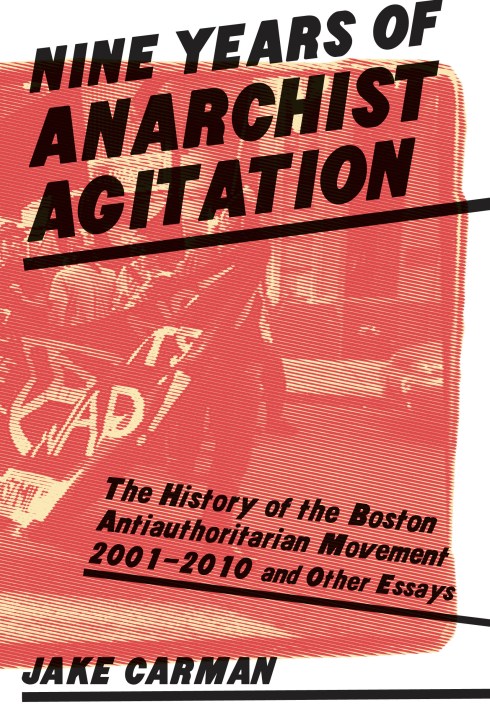
For Jake Carman’s first book, “Nine Years of Anarchist Agitation: the History of BAAM (2001-2010) and Other Essays”
At the Lucy Parsons Center,
358 Centre Street, Jamaica Plain
http://www.JakeCarman.com    Facebook.com/baamhistory

RSVP On Facebook

Come celebrate the long-awaited release of Jake Carman’s first book, “Nine Years of Anarchist Agitation: the History of BAAM (2001-2010) and Other Essays.” There will be snacks, music, a brief presentation, socializing, and copies of the book for sale.

About the Book:     In the wake of the September 11, 2001 attacks, and in the midst of the subsequent nationalist fervor, Boston radicals came together to form the Boston Anarchists Against Militarism (BAAM) Coalition. Through interviews and an extensive study of BAAM’s public statements, activities, and publications, this history explores the evolution of BAAM from an anti-war coalition into a general union of Boston anarchists. The lessons of the past decade are useful to today’s generation of activists as they grapple with the questions of political organization and activity in the struggle against global capitalism.
http://www.JakeCarman.com           Facebook.com/baamhistory

Thanks for Coming!

13 Nov

Image

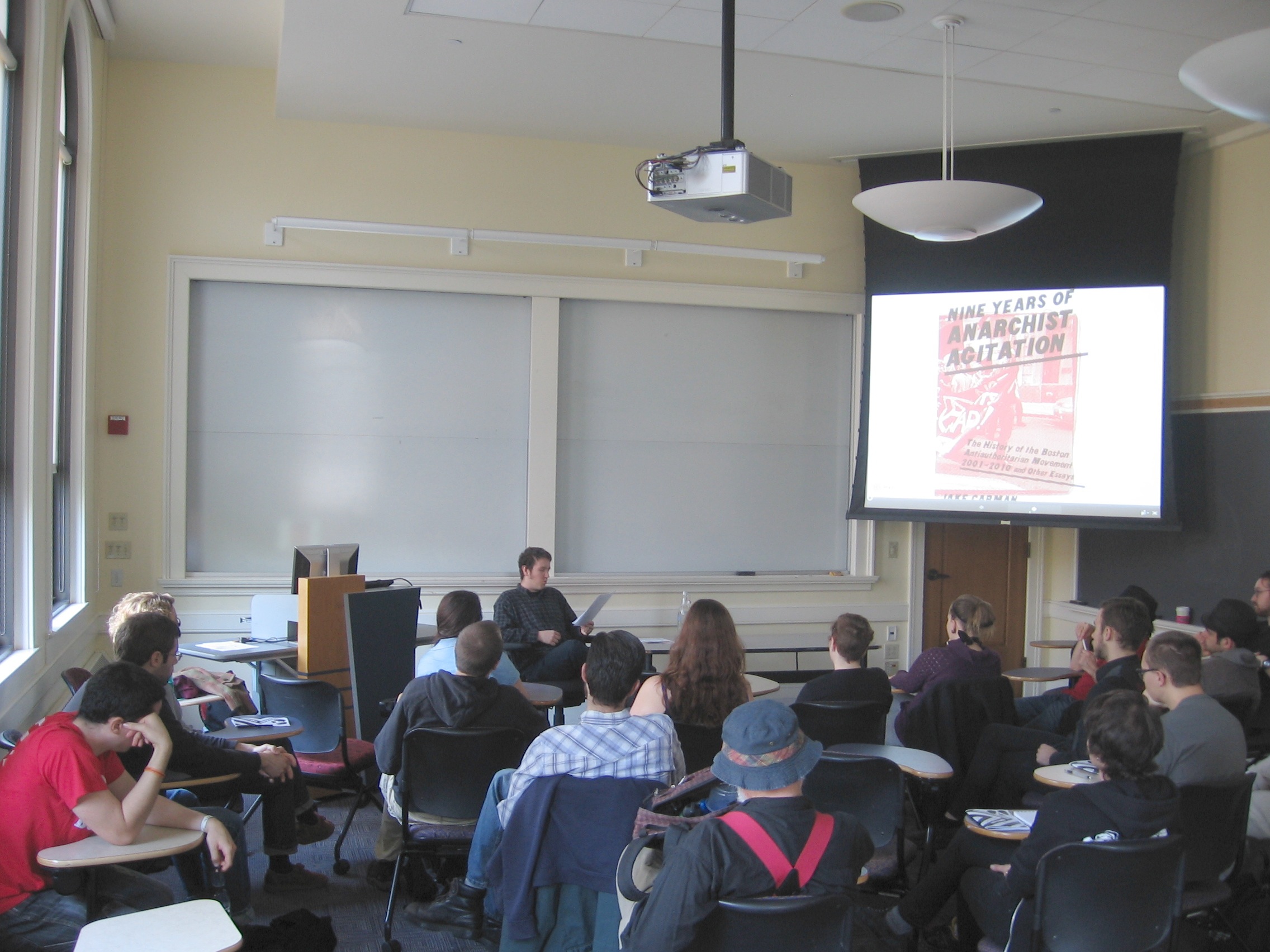
Almost 50 people came out on Sunday morning to see me present my book, “Nine Years of Anarchist Agitation: The History of BAAM and Other Essays.” The presentation went very well, despite my lack of sleep the night before due to our new born waking up to eat every hour! The one problem was I spent most of the hour and a half time allotted to me going through the history of BAAM and the surrounding anarchist community, and we didn’t have time to get to the part of the presentation I was most excited about: a discussion about revolutionary organizations, how they should function, what they should do, and what we’ve learned from past groups (like BAAM) that might contribute to the development of tomorrow’s revolutionary organizations. If you were sorely missing that discussion, you might check out the position one organization I’m in takes on this matter: The Question Of The Revolutionary Anarchist Organization: A Common Struggle Position Paper (adopted September 15, 2002) 

If you missed my talk, fear not! At the bookfair I discussed with some folks from the Lucy Parsons Center a plan to hold a book release party at their book store in Jamaica Plain. Stay tuned for the date!

          -Jake

(ps, thanks to Jerry Kaplan for these photos!)

Image


Tomorrow: I speak at the Boston Anarchist Bookfair

10 Nov

Hey everyone,

   I’m speaking tomorrow about my new book at the Boston Anarchist Bookfair. I’m worried about low turnout, as my workshop slot is the first of the day, and 11am can be early on a Sunday. That said, I hope you can make it, learn about the history of BAAM, and participate in a discussion about revolutionary organizations and our role as anarchists going forward!

Sunday, Nov. 11, 11am: Jake Carman speaks on his first book, Nine Years of Anarchist Agitation: The History of the Boston Anti-Authoritarian Movement (2001-2010) And Other Essays.
11am, at the Boston Anarchist Bookfair at Simmons College, 300 The Fenway, Boston, MA, room E305

Image

Come see local activist and author Jake Carman present his new book, which will be released on December 1st.

In the wake of the September 11, 2001 attacks, and in the midst of the subsequent nationalist fervor, Boston radicals came together to form the Boston Anarchists Against Militarism (BAAM) Coalition. Through interviews and an extensive study of BAAM’s public statements, activities, and publications, this history explores the evolution of BAAM from an anti-war coalition into a general union of Boston anarchists. The lessons of the past decade are useful to today’s generation of activists as they grapple with the questions of political organization and activity in the struggle against global capitalism.

To preorder your copy today for $15, email Jake at
Trenchesfullofpoets(at)riseup.net, or stop by his table at the Boston Anarchist Bookfair.

http://www.JakeCarman.com      –      Facebook.com/BAAMHistory

Nine Years of Anarchist Agitation: The History of the Boston Anti-Authoritarian Movement (2001-2010) And Other Essays. By Jake Carman

2 Nov

Nine Years of Anarchist Agitation: The History of the Boston Anti-Authoritarian Movement (2001-2010) And Other Essays. By Jake Carman

In the wake of the September 11, 2001 attacks, and in the midst of the sequent nationalist fervor, Boston radicals came together to form the Boston Anarchists Against Militarism (BAAM) Coalition. Through interviews and an extensive study of BAAM’s public statements, activities, and publications, this history explores the evolution of BAAM from an anti-war coalition into a general union of Boston anarchists. The lessons of the past decade are useful to today’s generation of activists as they grapple with the questions of political organization and activity in the struggle against global capitalism.


Click Here to Purchase your Copy!

Welcome to jakecarman.com!

2 Nov

Hey everyone! I’ve started a new website to help promote my first book: Nine Years of Anarchist Agitation: The History of the Boston Anti-Authoritarian Movement (2001-2010). The book will be released later this month. Until then, here’s my bio:

Jake Carman grew up in Franklin, MA, and developed an interest in anarchism at the age of thirteen. He became involved in the Boston anarchist community when the Iraq war began in 2003, and was a member of BAAM from 2003 until its disbanding in 2010. Jake helped to found the Anarchist Social Club at the Cambridge School of Weston, the Emerson Anti-Authoritarians, the Allston/Brighton Neighborhood Assembly, the BAAM Newsletter, and the Sacco and Vanzetti Commemoration Society. He is currently the secretary of the Boston Local Union of Common Struggle – Libertarian Communist Federation, the secretary of Freedom/Libertad newsletter, and a member of the Industrial Workers of the World. Jake lives in Watertown, MA, with his wife Clara and daughter Bridget, and when he is not organizing, enjoys playing music, football, and painting.