Archive | Uncategorized RSS feed for this section

The Republic Workers Remind Us That Direct Action Gets the Goods

17 Dec

The Boston Anti-Authoritarian Movement Newsletter, Issue # 16 – December 2008


At a time when big business is begging the government for big-money bail-outs and getting them, while workers get laid off and tenants and home owners get evicted, the employees of the Republic Windows and Doors factory in Chicago have taken matters into their own hands. And they have won. On December 5, 2008, following the announcement that the factory, which employs 300 people, would close in three days, 250 workers began a sit-down strike that may serve as a catalyst for a renaissance of working-class resistance throughout the United States. Republic CEO Rich Gillman informed the workers that although Bank of America recently received a $25 billion bailout, they were pulling their loan from the factory. As a result, Gillman gave his employees three days notice of the closure of Republic—well short of the 60 days notice required by federal law.

Facing the grim prospect of joining millions of others on the unemployment line, the workers, members of the United Electrical Workers (UE) Local 1110, refused to leave. They conducted a sit-down strike and took over the factory. The occupation lasted five days, and quickly won attention from the media, politicians, and others, and shamed Bank of America back to the bargaining table.

Well-known activist Reverend Jesse Jackson brought food to the workers and said, “These workers are to this struggle perhaps what Rosa Parks was to social justice 50 years ago… This, in many ways, is the beginning of a larger movement for mass action to resist economic violence.”

President-elect Barack Obama also offered his support. “When it comes to the situation here in Chicago” he said, “with the workers who are asking for their benefits and payments they have earned, I think they are absolutely right . . . what’s happening to them is reflective of what’s happening across this economy.”

On December 9, Illinois Governor Rod Blagojevich came out with a statement that his state’s government would boycott Bank of America until the loan to Republic was reinstated. The next morning, however, the FBI arrested the Governor for alleged corruption. As a result, the media that had gathered at the Republic factory left to cover the Governor’s arrest. All the cars on the street outside of the factory were towed. Workers inside issued a call in fear of a raid on their plant. The raid, however, never came.

The politicians and corporate media were not the only ones paying attention. According to Giuseppe, an eyewitness to the occupation, “there is definitely an increased sense of class consciousness…other workers have been inspired.” He also said that mainstream unions, which had previously shunned the UE, have pledged to use similar tactics. Republic workers have vowed to offer the same kind of solidarity and support they received to others struggling in the future.

After only five days of the occupation, the media attention, and the resulting public outcry, Bank of America agreed to reinstate some of its loan, along with $400,000 from JP Morgan Chase. According to Chicago Independent Media Center, “late Wednesday night…more than 200 workers and members of UE Local 1110 voted unanimously to accept a $1.75 million settlement that includes eight weeks of back pay, two months of continued health coverage, and compensation for unused vacation time.” “We fought to make them pay what they owe us, and we won,” said Local 1110 representatives.

Republic has stated that it will not reopen the plant, and neither will the landlord, the Mars Candy Corporation. According to Giuseppe, the union “has created the Windows of Opportunities Fund to raise money to buy the factory, which would make it essentially worker-managed. There hasn’t been discussion about what that would look like.”

As embattled Boston City Councilor Chuck Turner said in an interview, “The workers in Chicago are showing us the way…We see them stand up and say `If them, why not us.’ That’s the nature of evolutionary/revolutionary change.” Just like the Chicago workers who led the 1880s movement that won us the eight-hour day, the workers of the Republic Windows and Doors factory are an example to the rest of us. The government is willing to use our tax dollars to help the richest CEOs keep their companies, but when it comes to defending what is ours–our jobs, our homes, our communities, and our futures–the only way to win is to band together and fight back.

Southern Mexico’s Revolutionary Movements, and the Government’s New Plans to Crush Them

16 Dec

The Nor’easter, Issue # 1 – March 2008


On December 16, 2007, in Chiapas, Mexico, Subcomandante Marcos, military leader and one spokesperson of the Zapatista National Liberation Army (EZLN) delivered a speech entitled: “Feeling Red: The Calendar and the Geography of War.” During the speech Marcos said, “The signs of war on the horizon are clear,” and that he would withdraw from the public eye in preparation for an impending government invasion of Zapatista territory.

Here’s some background: On January 1, 1994, the small and poorly armed EZLN rose from the jungles of Mexico’s incredibly poor and mostly indigenous southern state of Chiapas to fight for autonomy. After a few days of unproductive conflict with the Mexican army, Marcos and his rebel comrades turned to the international media—the blossoming internet especially—to halt the government’s attack and spread their call for “Peace, Justice, and Democracy.” A cease-fire followed and since then, although the Mexican Government has continued what they call “low intensity warfare,” the Zapatistas have been winning the information war: a battle for the hearts and minds of their fellow Mexicans, rebels, and activists worldwide. The Zapatistas now control at least thirty-eight autonomous municipalities in Chiapas, but their influence is surely international.

According to Naomi Klein’s recent article for The Nation entitled “Zapatista Code Red,” “researchers at the Center of Political Analysis and Social and Economic Investigations have been tracking with their maps and charts. On the fifty-six permanent military bases that the Mexican state runs on indigenous land in Chiapas, there has been a marked increase in activity. Weapons and equipment are being dramatically upgraded, new battalions are moving in, including special forces—all signs of escalation.” This, in combination with an increase of the government’s use of paramilitaries to threaten, rape, murder, and maim Zapatistas and their supporters, explains why the rebels sense “war on the horizon.”

The recent government escalation should come as no surprise. Besides maintaining autonomy for twelve years, the Zapatistas launched a campaign in 2006—the Other Campaign—to empower and coordinate radical democratic social movements across Mexico. Instead of supporting any of the presidential candidates in the national election, the Other Campaign spearheaded a grassroots organizational surge against the Mexican Government and its political parties. This coincided with the height of the popular rebellion in Oaxaca, a state next to Chiapas, and along with the contested Presidential election results, the campaign may have bought valuable time for Oaxaca’s movement to blossom that summer.

When the electoral confusion died down by late fall, the government used a brute-faced military strategy to reclaim Oaxaca City in December and crush the movement for Popular Assemblies (or at least to drive the international media out) at a time when Oaxaca’s beautiful example seemed poised to destabilize the entire Mexican governing system. Before the government invasion, the people of thirteen different Mexican states had started Popular Assemblies, and everyone looked to Oaxaca to take the lead. Today, the government still represses Oaxaca’s continuing movement, even using paramilitaries against a youth march on January 15, 2007. But with international attention no longer on Oaxaca, the government has re-set its sights on the Zapatistas.

This is serious, comrades. We must fight with all our hearts and energy to defend every successful example of direct democracy and horizontal society. Since 1994, the Zapatistas have been invaluable to the development of social movements everywhere. The death of their autonomy will be a serious blow to the international struggle for liberation.

So what can you do about it?

The Boston Anti-Authoritarian Movement is calling for immediate action in solidarity with the Zapatistas as well as the people of Oaxaca. Please endorse, and more importantly, act (endorse with your feet!) our proposal for a coordinated effort to preempt Mexico’s invasion of autonomous rebel territory and end the police, paramilitary, and “low intensity” violence.

The first step is to inform the Mexican Government that we are aware of their plans and that we are prepared to act. Go to your Mexican Consulate, dress professionally, and ask for a meeting. Tell them your concerns, and give them the letter at the bottom of this article. Now, contacting the consulate is not always the most effective method, but if every consulate in the Northeast gets a visit, it’ll send a clear message. Also, mail or email a copy of the letter to the Mexican Secretary of Foreign Affairs, Patricia Espinosa: http://en.wikipedia.org/wiki/Minister_of_Foreign_Affairs_%28Mexico%29. This is a more direct way of letting them know we’re paying attention.

Step two is to prepare a coordinated response in the case of an invasion. Contact every local leftist, anti-authoritarian, grassroots, indigenous, immigrant, and community organization you can think of. Build a network, stay updated, and make concrete plans. Put up flyers and posters about the Zapatistas and Oaxaca to prepare the public community, so that when the war starts, they will know why we’re on the streets.

Step three is to plan and the implement creative direct action that will actually affect the Mexican Government. One idea is a campaign to discourage U.S. tourism to Mexico. You could also draw attention to companies with interests in Mexico. Please share these ideas as you come up with them. If you plan to hold protests or other traditional tactics, please consider your numbers, your message, and your audience to ensure maximum effectiveness.

According to Klein’s article, the Zapatistas feel “their calls for help are being met with a deafening silence.” The Zapatistas, through their dedication not only to their own liberation, but their tireless contribution to the global movements for freedom and equality, have inspired us all. They have reach beyond the borders of their autonomous rebel territory to spread the seeds of a bright future. It is time we return the favor and turn a “deafening silence” into a raging storm of action in defense of our southern comrades in struggle.


Zapatista Code Red!”

By Naomi Klein, The Nation. December 22, 2007.

http://www.thenation.com/doc/20080107/klein


Violence in Oaxaca:

Urban paramilitaries attack University”

By Simon Sedillo. El Enemigo Comun. January 15, 2008

http://elenemigocomun.net/1412#more-1412

Introduction to the History of the Boston Anti-Authoritarian Movement

15 Dec

*The History of BAAM (2001-2010)*

Autumn, 2011


Introduction


In every period of its existence, BAAM served as a vessel through which anarchists from a variety of sub-groupings and currents found common ground, and together presented ideas, critiques, and practices to the public. Over the course of the decade, BAAM exposed hundreds of people to anarchist ideas, helping dozens find the confidence and learn the skills to fight for social change. We always thought of BAAM as an opening. Countless people moved through it like a gateway to the radical movement. The vast majority of BAAM members and supporters moved on to other projects or other cities. In this way, BAAM’s biggest service was to educate and empower organizers and activists, who in turn are giving birth and lending help to continuing generations of subversive groups and struggles.

In August 2010, BAAM members decided to close the general union of Boston anarchists then called the Boston Anti-Authoritarian Movement. Many former members now work in organizations and struggles across the United States, while others back in Boston continue to meet on the first Tuesday of the month at the Lucy Parsons Center bookstore—as is BAAM tradition—regrouping, and bringing new faces into the discussion of the future of Boston anarchism.

The following is a history of BAAM through the first decade of the new century, from its inception as an anti-war coalition in September 2001, to its disintegration into a monthly anarchist assembly and potluck in August of 2010.


Order your Copy Tonight!

14 Dec

We are set to release the book on December 21st at a release party at the Lucy Parsons Center in Jamaica Plain. You are all invited, but if you are interested in getting an early copy, perhaps as a Xmas present for your comrades, you can do so at this web address:

https://www.createspace.com/4055947

“Nine Years of Anarchist Agitation: The History of BAAM and other Essays”

An article a day!

9 Dec

Hey all,

I’m going to publish on this blog one article from my new book a day for the next 12 days, as a countdown to the release party. Sign up to follow my blog to get the articles emailed to you!   Follow

To start it off, and as a late celebration of December 6th, the anniversary of the 2008 Greek Insurrection, here’s an interview I did with Athens members of the Greek Anti-Authoritarian Movement.

Violence is a Small River, To be with Society is an Ocean: An Interview with Athens Anti-Authoritarian Movement Comrades, August 2010, in Exarcheia, Greece.
The Defenestrator, Issue # 50 – December 2010

This August I interviewed three comrades from the Athens section of the Anti-Authoritarian Movement of Greece (Alpha Kappa/AK in the Greek acronym). The folks I interviewed live in Exarcheia, a neighborhood with a largely anarchist population in central Athens where the December 2008 Greek Uprising began, and around which two hundred police maintain a permanent security perimeter. AK, the largest anarchist organization in the country, is based around only three points of unity. These minimum core values are:

-The anti-authoritarian character of its scope and frame.

-The direct democracy in the way of decision-making.

-The denial of occupation of any form of power.

Vaggelis Nanos is in his early thirties. He helped found Nosotros, the first and largest social center in Exarcheia. He also works on Babylonia, AK’s monthly publication which is distributed in kiosks across the country. Sofia is also in her early thirties, and is a member of the AK working group for the creation of an anti-authoritarian economy. Epaminontas “Nontas” Skiftoulis joined the movement when it first began its struggle against the Military Junta in the early 1970s. He is quite influential for his ideas and articulateness. Police also accused him of being a member of an early anarchist guerrilla group.

What have anarchists in Greece done well that United States anarchists might learn from?

Vaggelis, as a proud founding member of Nosotros, insisted that Social Centers are an integral part of successful modern anarchist movements. His argument, which included tours of some spectacular spaces, was quite convincing. “In 2005,” Vaggelis began, “we started Nosotros. It was the first time we thought about social centers. What remains from the December 2008 uprising is that we have many social centers, which are some of the best things anarchists have made here. Some of these are occupied, some are rented. Some are for winter, some for summer, like the self-organized park Navarinou.” Nosotros, like the other social centers we saw, is a large building with classrooms, computer rooms, libraries, offices, child-care centers, film and music spaces, and invariably an indoor bar for winter and an outdoor bar for summer. Navarinou in Exarcheia is a rare place: a park in the concrete landscape of Athens. Once a parking lot, the people of the neighborhood tore up the pavement, put in soil, built a playground, planted trees and bushes, and built a stage with some seats for discussions, music, and film screenings. Thus they created an autonomous park in a city sorely lacking in parks.

Vaggelis described the essential part that Greece’s social centers play in the struggle: “Firstly, they are spaces for meetings. Secondly, the free spaces are run by assemblies. So it’s an experiment to see if we can run spaces completely with no leaders. So far, it’s working. At Nosotros, we have lessons for immigrants and students, lessons in instruments, and more. If you know something, here you can teach it to others. The social centers are also the point from which we start to organize resistance to everything. When there is a problem in the neighborhood, we go there.”

What mistakes have the Greek anarchists made that we in the U.S. may learn from?

Sofia told of an act that happened as the Greek Parliament was voting for the IMF bail-out: “On the 5th of May, 2010, there was a huge manifestation. People said they hadn’t seen one so big since the first years of the dictatorship. During the manifestation, some people burnt down a bank. Three people who were trapped inside were killed. It hasn’t been proven that those who torched the banks were anarchists, but most likely they call themselves anarchists. That morning, society had welcomed anarchist ideas. Afterward, we had to apologize for an incident committed by about three people whom we feel acted against all those who participated in the demonstration. Maybe somewhere it’s written that anarchists should burn banks, but we have to think about what’s good in a certain situation.”

“Similarly,” she continued, “after December 2008, the movement was still going on, but a guerrilla anarchist group shot at policemen in Exarcheia. Three hundred police were hurt during December, and people were fighting alongside us almost every day in the streets. But one shot against one cop turned the people against the movement again. We took a step backwards.”

“There are many big mistakes, so what?” Vaggelis said. “But the idea that we know the truth is our biggest mistake. Most anarchists believe we know the truth and the people don’t, so the people must follow us. For example, there was a park called the Self-Organized Park of Cyprus and Paticion. The people occupied the park and self-organized. Anarchists went there and said, “this isn’t anarchist enough. We can’t sell beer. We can’t have this concert because the singer isn’t anarchist.” So in two month’s time, the only people who went there were anarchists. Many times we prefer pure anarchy than to have a relationship with society. This is a mistake. Like Marxism and Stalinism, if you believe completely in it and don’t allow criticism, we are no better than them. We go straight to one closed system.”

When Nicholas Stylopoulos (also from AK and Babylonia)came through Boston to speak, he explained that Greek anarchists had the power on the streets, and that “If we had two hundred thousand people, we’d overthrow the government, but then what? That’s the problem…we don’t have a message. People on the street want a plan.”

“Yes, we are very good fighters,” Vaggelis said, “but we don’t have the ways to run society. We have no structure to offer. The truth is, if we want to have these structures we must build them with society, which knows how to produce, how to distribute the things she needs. Together we must plan the society we all want. We can’t isolate ourselves. After December, many of us can see this problem. Maybe lectures are something society needs, but how are we going to take the products of the countryside to the city? We haven’t found out yet how things will be after the revolution. How will we decide what kind and how much energy to use—gas, sun, solar, nuclear?”

“The point is, we need to build more movements. If we have a big Eco movement, and another one of people from neighborhoods, the two together can decide what energy to use. If we have a strong farmers’ movement, we can build horizontal farms to produce and share with cities. Some of these farms exist, and sell to Nosotros and other social spaces, but we don’t know how to do this on a larger scale. There are four million people in Athens, three million between the three other big cities, and only three million in the countryside. Only one thousand are farmers, and only one hundred are anarchist farmers. So how do we feed the cities?”

“We’ve thought of problems we’ll have after the revolution, but we can’t predict what will happen. Marx said Russia can’t have a revolution, it’s only farmers. He said only Germany can. Germany had the Nazis, and Russia had the revolution! How will we run schools, and technology? Do we need these or not? Revolution is full of problems. But from the other side, this is nice about revolution: together we figure this out.”

“First, we need experiments. Alternative schools, farms that have direct relationships with the city. If these work, then more people will do it that way. One day the revolution will come, and we won’t even notice it. We must get to the point where both sides have no other choice. We are far from this.”

Responding to my question about whether the solutions of classical anarchists have been useful, Vaggelis said, “Authority nowadays is more complicated than it used to be. We have to win many more fights, be equal with women, gays, the environment. In 1900, Kropotkin said, “The machines will save us.” Today we say, “The machines will pollute too much,” so we can’t just trust these dead guys. They’re too old. I love them, but we can’t trust them. For instance, nobody today says “I’m a worker.” We have one hundred hobbies. We can’t say, “We’ll go to a union and have a revolution.” We don’t all care about our jobs. Work is important. We spend more than eight hours a day there. But there’s more, too.”

How are Greek anarchists addressing these obstacles?

Sofia suggested, “Greek anarchists must overcome ideology, to learn to be with society and live within it, not outside it. That’s what we’ve tried to do here in Exarcheia. After December 2008, people, not only anarchists, occupied public spaces and tried to manage these places using direct democracy. Also, here there are many anarchists who are open minded and try to build structures, and there are others who are not. I can’t speak of anarchists as a unified thing.”

As for Alpha Kappa, Sofia continued, “At the May conference we concluded that we want to work on a project of an anti-authoritarian economy, exploring the values and the key issues and the applications it can have. That’s why a new work group has been formed. It meets once per month. So far we’ve agreed on some main principles that such an economical system should be based on: justice, autonomy, ecological harmony, diversity. We have studied several alternative economical systems proposed by Albert, Fotopoulos, and Latouche (degrowth), in order to identify their proposals according to some main issues such as property, labour, and decision making inside such an economic system. We agreed to present every month the progress of the meeting in an article published in Babylonia and in an open discussion at Nosotros.” At AK’s Festival of Direct Democracy, held in Thessaloniki in September, the entire second day, called “Exodus from Capitalism,” will focus on the anti-authoritarian economy. As Sofia said, the research process “will last at least one year and hopefully we will have some fruitful results.”

Vaggelis added, “I think now we are starting to try to build these structures, both in Alpha Kappa and in other organizations, but we are at the beginning. We have bookstores, bars, restaurants that work collectively, but too few. We must do this much more to see if this experiment will work.”

How can United States anarchists help the Greek anarchist movement?

Nontas, sitting outside one such anarchist bar, said, “You are helpful in many ways, but you don’t know it yet. At this moment, in order for Greek society to operate again, we need an alternative solution. Because of the rotting state, which can’t give society solutions, the economy doesn’t work anymore. Society’s institutions have been destroyed, like families, education, etc. We are living without meaning, living for ourselves and not a community.”

“We need a solution that’s not ideological, not theological, not messianic, but a direct, logical, rational solution….That’s why we study and invite to our festivals American intellectual radicals. For example, we have used Michael Albert’s book Parecon in our analysis of farmers, small cooperatives, and buyers, as against the middle man. Another example, we used (David) Graeber’s suggestion of substituting the language of anarchism with direct democracy when speaking with society. So when the prisoners revolt we don’t impose our ideas about imprisonment, but instead hold assemblies and together discuss the demands such a movement can pose.

“You in the US can further help us with protests outside travel agencies and by sending us reports about solidarity actions. You can do a lot for Greece. Now is the right time because the Greek people are waiting to hear from other countries.”

As for the present, Vaggelis says, “what we can do for each other is to have actions. When in December you did actions for us we felt we are not alone, so we must go on! The same we can do for you. This is a nice thing.” Money from the resource-rich United States, Vaggelis said, is not necessary nor desired from Greek comrades. “When we had a little social center, we couldn’t pay the rent. Then we said ‘we’ll rent this bigger building, $2000 Euros a month plus $1500 to fix it.’ We found the money in one month, because we believed in that project. We don’t need anything else. We don’t want your bloody dollars,” he laughed.

How might Greek Anarchists help U.S. Anarchists?

Vaggelis began by suggesting (jokingly?) that Greek anarchists pay for social centers in the United States. Then Vaggelis, who is by no means a pacifist and frequently delighted in showing us Youtube videos of Greek anarchists fighting police, said, “We only do bad things for anarchists elsewhere. People in the United States are starting to believe that fighting is more important than ideas and organizing. Fighting is important, but really the ideas are more important. To have the streets is important, but to do that you must glue the streets with posters, to give the people your papers, and to explain to them what you believe. The last step is fighting the cops. You need all of that—the ideas, the effort, the organizing—to win the streets, not just the stones. It’s psychologically easy to fight the cops. You just throw stones, then run away. It’s easy to be a macho guy, but you can beat the baby, or you can teach it.”

“We must sometimes have violence, but our purpose is not just to have the fight. In ’95, the Polytechnic school was occupied for three days, so we were fighting the cops. Five hundred people were arrested. After that it took many years to have a demonstration with a lot of people. Fights can do some things, but they can just as easily undo things. As we say, its like an umbrella: if it’s raining, you take it. If not, you leave it at home!”

Nontas spoke similarly: “Here in Greece, the purity of action and activism, the romanticism of the action prevents the reflection and digestion of what we have done until now. Our youngest anarchists have already thrown one billion stones, built one hundred bombs, and fought the police. Today we have thirty anarchists in prison. There are thousands who have gone to prison. We don’t only need people to throw stones, we need people to talk to society so they can understand and accept what we propose. We need to be specific about what we propose or else they say ‘Bullshit!’ to us. When you can relate to society, you have escaped the activism plague.”

“Everything is starting with the thought. Violence is a small river, to be with society is an ocean. Anarchy is a great, open road. We can’t close it. We must discover it little by little by working.”

Sofia concluded, “What we need to do is to use our imagination and overcome what is posed to us by the status quo and build structures that are based on principles other than those that are imposed on us. For instance, instead of capital being the major purpose, human dignity and nature should be taken into account.”

“So whether we manage to build such structures or you do, it will help all the others because in doing so we will have discovered the path. So what we all have to do is to try to build the structures not only globally, but try to apply these principles locally like an experiment. I think these experiments can occur even now inside capitalism, and if they prove to be successful, then we can apply them on a larger scale.”

Image

Book Release Party

6 Dec

Book Release Party

Here’s the flier. Tell your friends!

Book Release Party!

6 Dec

Friday, December 21st, 2012, 6-8pm
Book Release Party!
For Jake Carman’s first book, “Nine Years of Anarchist Agitation: the History of BAAM (2001-2010) and Other Essays”
At the Lucy Parsons Center,
358 Centre Street, Jamaica Plain
http://www.JakeCarman.com    Facebook.com/baamhistory

RSVP On Facebook

Come celebrate the long-awaited release of Jake Carman’s first book, “Nine Years of Anarchist Agitation: the History of BAAM (2001-2010) and Other Essays.” There will be snacks, music, a brief presentation, socializing, and copies of the book for sale.

About the Book:     In the wake of the September 11, 2001 attacks, and in the midst of the subsequent nationalist fervor, Boston radicals came together to form the Boston Anarchists Against Militarism (BAAM) Coalition. Through interviews and an extensive study of BAAM’s public statements, activities, and publications, this history explores the evolution of BAAM from an anti-war coalition into a general union of Boston anarchists. The lessons of the past decade are useful to today’s generation of activists as they grapple with the questions of political organization and activity in the struggle against global capitalism.
http://www.JakeCarman.com           Facebook.com/baamhistory

Thanks for Coming!

13 Nov

Image

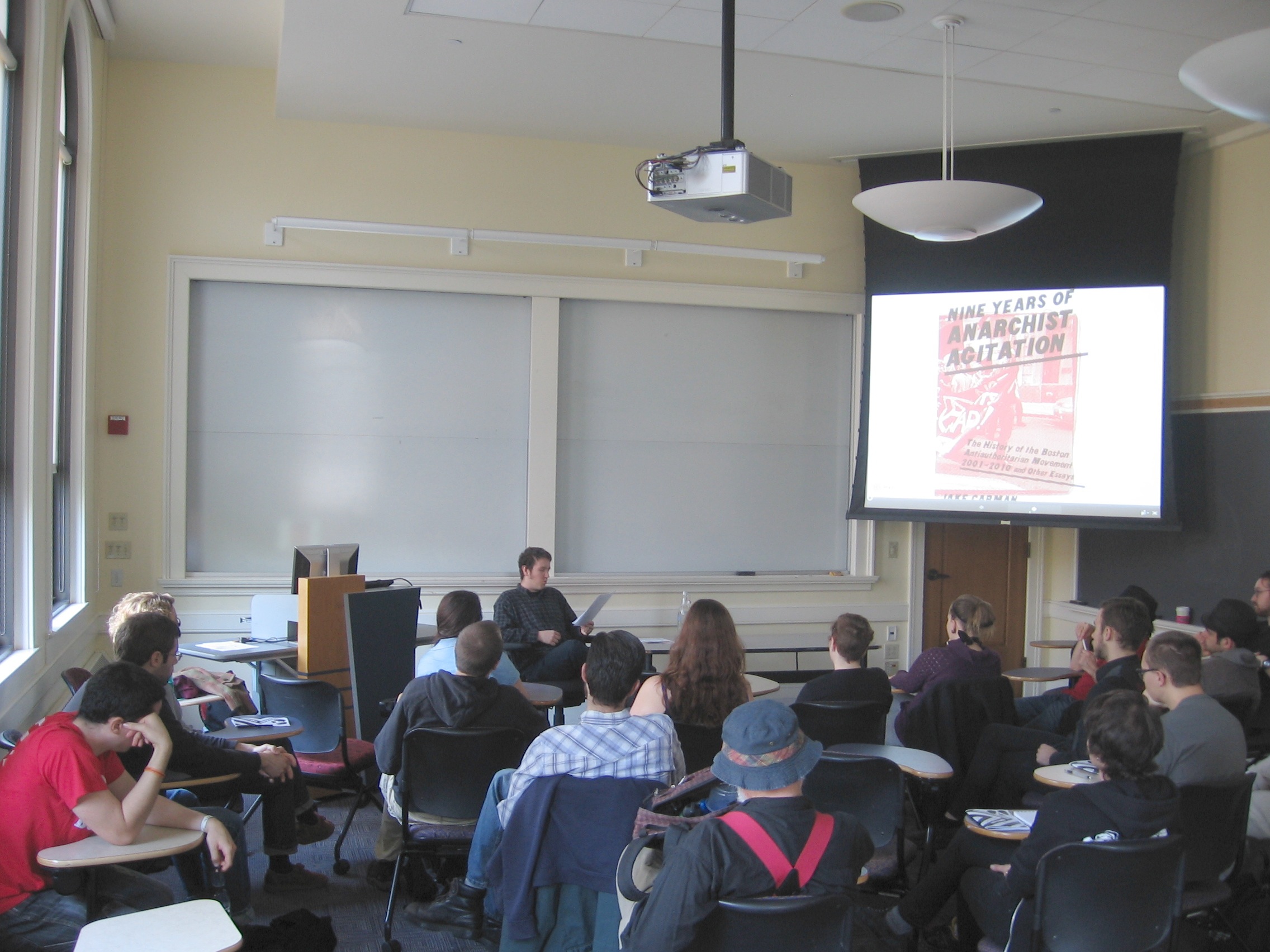
Almost 50 people came out on Sunday morning to see me present my book, “Nine Years of Anarchist Agitation: The History of BAAM and Other Essays.” The presentation went very well, despite my lack of sleep the night before due to our new born waking up to eat every hour! The one problem was I spent most of the hour and a half time allotted to me going through the history of BAAM and the surrounding anarchist community, and we didn’t have time to get to the part of the presentation I was most excited about: a discussion about revolutionary organizations, how they should function, what they should do, and what we’ve learned from past groups (like BAAM) that might contribute to the development of tomorrow’s revolutionary organizations. If you were sorely missing that discussion, you might check out the position one organization I’m in takes on this matter: The Question Of The Revolutionary Anarchist Organization: A Common Struggle Position Paper (adopted September 15, 2002) 

If you missed my talk, fear not! At the bookfair I discussed with some folks from the Lucy Parsons Center a plan to hold a book release party at their book store in Jamaica Plain. Stay tuned for the date!

          -Jake

(ps, thanks to Jerry Kaplan for these photos!)

Image


Tomorrow: I speak at the Boston Anarchist Bookfair

10 Nov

Hey everyone,

   I’m speaking tomorrow about my new book at the Boston Anarchist Bookfair. I’m worried about low turnout, as my workshop slot is the first of the day, and 11am can be early on a Sunday. That said, I hope you can make it, learn about the history of BAAM, and participate in a discussion about revolutionary organizations and our role as anarchists going forward!

Sunday, Nov. 11, 11am: Jake Carman speaks on his first book, Nine Years of Anarchist Agitation: The History of the Boston Anti-Authoritarian Movement (2001-2010) And Other Essays.
11am, at the Boston Anarchist Bookfair at Simmons College, 300 The Fenway, Boston, MA, room E305

Image

Come see local activist and author Jake Carman present his new book, which will be released on December 1st.

In the wake of the September 11, 2001 attacks, and in the midst of the subsequent nationalist fervor, Boston radicals came together to form the Boston Anarchists Against Militarism (BAAM) Coalition. Through interviews and an extensive study of BAAM’s public statements, activities, and publications, this history explores the evolution of BAAM from an anti-war coalition into a general union of Boston anarchists. The lessons of the past decade are useful to today’s generation of activists as they grapple with the questions of political organization and activity in the struggle against global capitalism.

To preorder your copy today for $15, email Jake at
Trenchesfullofpoets(at)riseup.net, or stop by his table at the Boston Anarchist Bookfair.

http://www.JakeCarman.com      –      Facebook.com/BAAMHistory

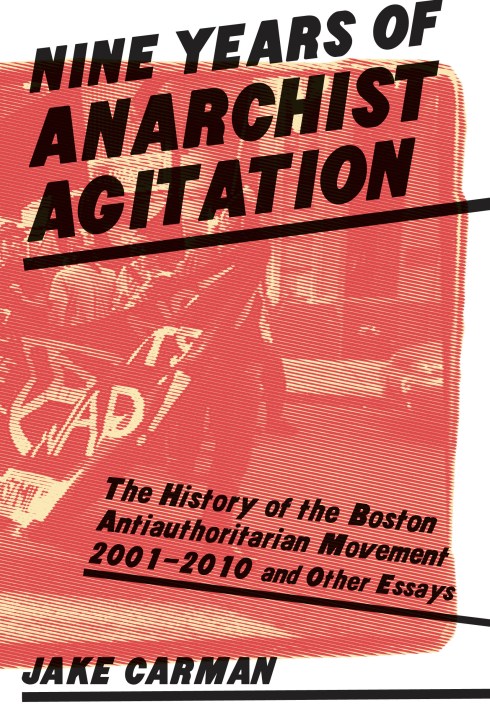
Nine Years of Anarchist Agitation: The History of the Boston Anti-Authoritarian Movement (2001-2010) And Other Essays. By Jake Carman

2 Nov

Nine Years of Anarchist Agitation: The History of the Boston Anti-Authoritarian Movement (2001-2010) And Other Essays. By Jake Carman

In the wake of the September 11, 2001 attacks, and in the midst of the sequent nationalist fervor, Boston radicals came together to form the Boston Anarchists Against Militarism (BAAM) Coalition. Through interviews and an extensive study of BAAM’s public statements, activities, and publications, this history explores the evolution of BAAM from an anti-war coalition into a general union of Boston anarchists. The lessons of the past decade are useful to today’s generation of activists as they grapple with the questions of political organization and activity in the struggle against global capitalism.


Click Here to Purchase your Copy!