Archive | Uncategorized RSS feed for this section

New Article: Boston Suffers in The Year of the Landlord

11 Jun

Boston Suffers in The Year of the Landlord

From the Cradle of Liberty News Issue 2 – June 2013 – http://cradleoflibertynews.org/boston-suffers-in-the-year-of-the-landlord/

By Jake Carman

This spring, rents skyrocketed across the greater Boston area, forcing tenants to move further from their jobs, communities, schools, and families. Tough competition for dwindling more-affordable housing contributed to the high prices in a city second only to San Francisco for the lowest rate of apartment vacancies. Meanwhile, many landlords sold their holdings to developers to be turned into more-expensive—and thus profitable—condos, further depleting living units for working class people. Landlords have capitalized on a shortage of available properties, which are thus in high demand, to rake in profit at the expense of tenants. These changes hurry along the process of gentrification, which redevelops working class neighborhoods for the use of wealthier residents.

Property Neglected By Landlord. Photo By Jake Carman
YearofhteLandlord1

CBS reports 8.6 percent rent hikes, presumably for two bedroom apartments “to an average of $1,945 in Greater Boston, compared with the national average of $1,066.” A report cited by WBUR states “the average cost per bedroom in 2013 is $1,314. In 2011, the average cost per bedroom was $1,141.”  Cambridge rents increased 11 percent. Even as far as Revere, on the northern reaches of the greater Boston area, “there are nearly no rental units on the market, and any that are on the market are very high priced,” according to the Revere Journal.

“It’s definitely the year of the landlord,” Keith Harrington, co-owner of Boston-based property manager Hillway Realty Group, told CBS. He’s “seen rent hikes of 7 to10 percent since January.”

Meanwhile, a recent study by the National Low Income Housing Coalition shows that a worker, earning minimum wage, would have to work 110 hours per week to afford a two-bedroom apartment. This is based on a state-wide average, in which Boston represents the high end. Even in a household with two earners, they would each need more than one full-time job.

The shortage itself may be caused by the influx of wealthy students and young urban professionals into Boston in recent years. While this certainly is not a new process, the wealthy have now packed the central neighborhoods of Boston so tightly that the remaining condos are coveted and prices are skyrocketing. According to the Globe, “there were only 291 downtown condo units for sale in March compared with 693 in March 2012,” and the prices were up over 7%. Developers have turned to the lower property costs of outlying and working class neighborhoods and towns to build new condos and other high-end housing.

This process aids gentrification in two ways: it turns more affordable properties into condos and other housing for the wealthy and reduces the number of homes available to working people. The spending ability of the new, richer neighbors allows area landlords to raise rents, and business owners to charge more for staple products and services. Gentrification transforms low-income areas, driving up rents and the cost of living, forcing working people to relocate. Central Square in Cambridge, for example, one of that city’s few remaining working class neighborhoods, “saw the biggest increase in rents at 20.6 percent to $2,892,” according to the Globe.

I experienced the problem firsthand in May, when a new landlord bought the house I am living in with my wife and six-month-old daughter and asked us to break the lease and move out. The buyer is gutting the house to turn it into condos.

The Cradle of Liberty spoke to many Boston-area residents who face rent hikes this year. The tenants’ names have been changed to protect them from any retaliation from their landlords.

Ann Marie, a 49-year-old Brazilian immigrant who has lived in the United States for decades. Working full time in a grocery store and part time in a restaurant, she moved in to a two-bedroom apartment in East Somerville in February of 2011. Her family paid $1300, on a month-to-month basis, to a single-owner landlord for an old, neglected house in need of repair, until a new landlord bought the property in March. The new owner, according to Ann Marie, “sent a rude letter” in which he tried to intimidate the Portuguese-speaking family. Marie said he “gave us one month to move out. I got so stressed, because I was worried about my family. My father and mother are old and stressed too. We found a new place fast, thank God.” They moved on April 5th in to another two-bedroom apartment in Somerville, for $200 more a month, and had to pay the full broker’s fee on top of two months of rent. While their old house sits empty, with no signs of construction two months later, Ann Marie and her family are happy with the new place.
Gillian C., a communications director who lives in Watertown, has been renting a two-bedroom apartment with her husband since 2007, “in an apartment complex near Watertown Square, owned and managed by the Hamilton Company, one of the largest rental property firms in the state. I believe the rent was $1425 when we moved in.” The rent went up every year, Gillian told Cradle of Liberty, but only by $25 or $50. “Our lease is up September 1st, but we received a letter under our door in January, notification that the rent would be increasing by $150 to $1725. The letter asked us to indicate if we plan to renew or are leaving. It is a bit odd to get a lease renewal so far in advance of the lease expiration but this is how they’ve always done it since we moved in… But it’s obvious that they are trying to lock people in or scare them into signing.” The rent increase has encouraged Gillian and her husband to attempt to buy a house, but with home prices climbing dramatically and in short supply, they have had no luck.
Gillian’s nephew, Joe M., a drum instructor and caterer, who rents another apartment managed by the Hamilton Company with his girlfriend on the other side of Watertown Square, has also received a rent increase notification. Joe moved in July 1st, 2012, and is paying $1,500 for a two-bedroom apartment. This past winter, the Hamilton Company informed them of a $100 rent hike in July. Joe and his girlfriend are currently trying to find a one-bedroom apartment, “because two bedrooms are now out of our price range.” They have already been searching the greater Boston area for two months, but, like everyone else, are having a hard time.

Mary, who lives in a cooperative house in Allston, told the Cradle of Liberty that her landlord planned to raise the rent of their house too. As the tenant liaison between the cooperative and the landlord, Mary undertook negotiations with the landlord. “Last year, our landlord proposed a $200 per floor rent increase, which we felt was unfair.  We haggled over the rent increase, then finally settled on a $100 per floor increase, with a two year lease.  So no rent increase this year.”

Others like Mary and her housemates are resisting what they see as landlords’ onslaught on tenants. Renters in Malden and Medford have come together to resist rent increases at one small and three large apartments bought out by City Realty, which plans to raise rents across the board. Medford/Malden Tenants United acts like a union, allowing tenants to exert their collective power through protest and negotiations. They, however, represent a very small percentage of tenants, most of whom have no
organization and little knowledge of their rights as tenants.

Gillian continues, “I’ve been renting in the Watertown and Newton areas for the last 15 years and the rents have increased quite a bit. My first apartment was in a similar complex to this one, I lived with a roommate in a two-bedroom and the rent was $950. Total. I think I paid $450 since I had the smaller bedroom. The figure seems so laughable now. It’s not just in Watertown. Rents are going up all over the state. And we have no choice.”
A Transforming Watertown Neighborhood. Photo By Jake Carman
YearofhteLandlord2
Work Cited:
High Demand Sends Greater Boston Apartment Rents Soaring
By Brendan Lynch, Special to the Boston Business Journal
May 29, 2012 7:36 AM
http://boston.cbslocal.com/2012/05/29/high-demand-sends-greater-boston-apartment-rents-soaring/

Boston condo market strong in 1st quarter
Downtown prices hit record median value of $537,000
By Jenifer B. McKim, Globe Staff, May 01, 2013
http://www.bostonglobe.com/business/2013/04/30/boston-downtown-condo-market-hits-record-median-value-first-quarter/dJHLQUn2S6Hxt8t14uKuvL/story.html

What The Cost Of Renting An Apartment In Boston Looks Like
By Nate Goldman January 30, 2013, WBUR
http://www.wbur.org/2013/01/30/boston-apartments-heat-map

Revere Market Heating Up Again
May 9, 2013. By Seth Daniel. Revere Journal
http://www.reverejournal.com/2013/05/09/revere-market-heating-up-again/

Hours at Minimum Wage Needed to Afford Rent Map
National Low Income Housing Coalition
nlihc.org/sites/default/files/oor/2013_OOR_Minimum_Wage_Map.pdf

Tenants protest rent hikes
But new owners cite below-market rates
http://www.boston.com/news/local/massachusetts/articles/2012/05/13/tenants_protest_hikes_imposed_by_new_landlord

Image

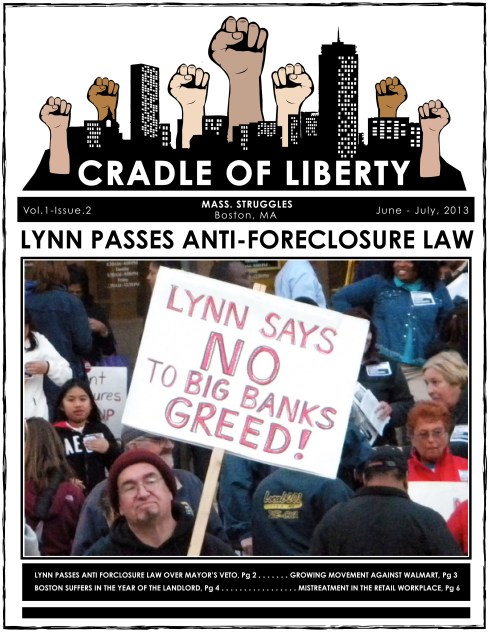
Cradle of Liberty Issue #2

10 Jun

Cradle of Liberty Issue #2

Check out Issue # 2 of The Cradle of Liberty, an every-other-month Boston-area workers’ newsletter that I helped found and write for.

Pasta dinner to benefit the Cradle of Liberty publication!

8 May

Please tell your friends and coworkers!

This Saturday, May 11, 2013 – Please join us for a pasta dinner to benefit the Cradle of Liberty publication

6:00pm -8:00pm at the Community Church of Boston, 565 Boylston St, Boston, MA 02116, in Copley Square.

Come celebrate a new publication, the Cradle of Liberty, and help ensure a future for the paper with a pasta social: food, drinks, and socializing. Suggested donation of $5-$10.
 – Co-sponsored by the Community Church of Boston

 For more information:

http://www.CradleofLibertyNews.org
http://www.facebook.com/CradleofLibertyNews

Want to support this paper in other ways? Support the paper by writing for it or publishing your events in the calendar:

Call For Submissions!
The Cradle of Liberty Collective is looking for news articles, editorials, short essays, and event announcements relevant to the Massachusetts working class community. The next issue of *Cradle of Liberty*, a bi-monthly newspaper, will be published in June and we are currently soliciting submissions. If this sounds appealing to you and you would like to submit an article or would like to get involved in any other way, please get in touch. If you cannot submit content, we are also looking for financial support in producing this free publication. For the next issue, we ask that all content be submitted by May 18th. Contact us at CradleofLibertyNews@gmail.com
Check out Issue #1 here: http://cradleoflibertynews.org/?page_id=126

If you are interested in writing, but don’t know what to write about, take a look at the calendar of upcoming Boston-area events on our website and consider writing a report about one. If you have never written before or would like some pointers or suggestions, feel free to email us at: CradleofLibertyNews@gmail.com

History of May Day

1 May

Hey friends,

  Below is an essay that appeared in my book, Nine Years of Anarchist Agitation: The History of BAAM, and Other Essays. We ran various versions of this article in the old BAAM Newsletter, updating it each May. Enjoy, and hope to see you in the streets today!

       -Jake Carman


How Migrant Workers Won the Eight-hour Day: A History of May Day

The Boston Anti-Authoritarian Movement Newsletter, Issue # 33 – May, 2010


In the United States in the late 1800s, workers in general and migrant workers in particular faced abysmal conditions on the job. Workers, including children, could suffer sixteen or more hours a day under dangerous, stifling, sweatshop conditions to earn starvation wages and live in cramped quarters. Like today, workers poured in from all over the world to pursue the American Dream through their own honest labor. Workers came from Ireland, Italy, Germany, China, Russia, Japan, Spain, Mexico, Norway, Syria, Slovakia, Poland, and elsewhere in search of better lives. When they arrived, however, they faced blatant racism and hate, just like migrant workers do today. Eking out hard livings in tight-knit ethnic communities, most were considered second-class citizens, regarded as diseased criminals, untrustworthy scoundrels, and, more importantly, a cheap and dispensable source of labor.

Comparing their tortured conditions to the lives of luxury and leisure that their labor provided to the factory owners and bosses, these workers became determined to do more than exist as slaves; they would organize and win for themselves lives worthy of humans. Many immigrants brought with them the radical traditions of their native countries. Anarchists, socialists, and other revolutionaries found eager ears among their fellow workers, foreign and native-born alike. Recognizing the injustices of the United States, they dreamt of a world where workers control the products of their labor, where all people have access to food and housing, and where communities, not politicians and bosses, make the decisions.

A movement for the eight-hour day started gaining momentum across the country. This struggle, undertaken by reformers and radicals alike, demanded eight hours for work, eight for sleep, and eight for leisure. Chicago’s strong labor movement pressed for, and was rewarded with, eight-hour legislation in 1867, to be enacted May 1. However, when that day came, the bosses refused to respect it and the government didn’t force them to. Chicago’s militant, organized workers went on strike to protest, but the police brutally crushed their resistance within a week and the despondent workers returned to their jobs. The only thing that changed for Chicago’s toilers is that they lost confidence that change could be achieved through legislation.

This rejection of reformism remained in the collective memory of Chicago’s workers and by 1886, another, more radical eight-hour movement sprang up. Led by migrant and other workers of the anarchist International Working People’s Association (IWPA), a general strike was planned for May 1 to proclaim the power and strength of Chicago’s determined workers. On May 1, 1886, 400,000 went on strike in Chicago, with another 350,000 joining them across the nation. Eighty thousand people marched through Chicago’s streets on May Day, defying the artificial boundaries the rulers used to divide them—race, sex, nationality, and trade—and their demonstration of unity terrified the upper class. Determined not to concede anything and to hoard all of the wealth they had robbed from the poor, the rich set out to crush the movement with violence.


Labor Crucified

The workers’ momentum continued with strikes and demonstrations. On May 3, the striking “lumber shovers” union held a public meeting of 6,000 near the McCormick plant. The police, loyally serving and protecting the interests of wealthy capitalists, attacked the meeting with guns and batons, killing one worker and wounding more. Outraged, anarchists posted a call in their daily German-language paper, the Arbeiter-Zeitung (“Workers’ Newspaper”) for a May 4 protest meeting at Haymarket Square.

On May 4, thousands gathered at Haymarket to denounce police violence. The crowd listened to speeches by migrant anarchist workers, such as August Spies and Samuel Fielden. Even the mayor of Chicago, who attended the beginning half of the rally, said, “nothing looked likely to happen to require police interference,” and he advised police captain Bonfield to send his forces home. Bonfield didn’t. Around 10 P.M., after the mayor and many attendees left, and as Fielden was calling the meeting to a close, Bonfield’s force of two-hundred officers marched on the rally, threatening violence and demanding it break up. Just then, someone threw a bomb at the police, killing one instantly and injuring many. In the chaos, police fired indiscriminately, killing seven of their own officers and numerous demonstrators, though they never counted how many workers they slaughtered.

A reign of terror followed while the state prosecutor publicly advised the police to target anarchists: “make the raids first and look up the law afterwards.” Police arrested all known anarchists and raided meeting halls, printing offices, and homes. Eight prominent anarchists, newspaper editors, and unionists were charged with the Haymarket bombing. They were August Spies, Sam Fielden, Albert Parsons, Adolph Fischer, George Engel, Michael Schwab, Louis Lingg, and Oscar Neebe. Of the eight men, seven were immigrants, and only three were at Haymarket that night. The state prosecutor handpicked a biased jury, and presented no evidence connecting the accused to the bomb. As the prosecution argued in court, “Anarchy is on trial. These men have been selected, picked out by the Grand Jury, and indicted because they were leaders. They are no more guilty than the thousands who follow them. Gentlemen of the jury; convict these men, make examples of them, hang them and you save our institutions, our society.” So they did.

A massive international campaign for their freedom emerged, led by Lucy Parsons, wife of Albert and a skilled labor organizer in her own right. In response, the state commuted the sentences of Schwab and Fielden to life imprisonment, and Neebe got fifteen years. The gallows awaited the rest. The fiery young German carpenter, Louis Lingg, cheated the hangman. He committed suicide in his cell the day before his execution. On November 11, 1887, Parsons, Engel, Spies, and Fischer were hanged. Six hundred thousand people attended their funeral.

The state murdered those five anarchist organizers. At the time it was seen as a setback for the eight-hour movement, but the event radicalized many more, like Emma Goldman and Voltairine de Cleyre, who later became influential anarchists. Their radical careers were inspired by the anarchists of Chicago.

The American Federation of Labor and the anarchist IWPA took the streets again on May Day, 1890, and the movement for the eight-hour day pressed on. Carrying on the legacy of the Haymarket Martyrs, organized labor began to make headway. The United Mine Workers achieved the eight-hour day in 1898, as did the Building Trades Council of San Francisco in 1900, printing trades across the U.S. in 1905, and Ford Motor workers in 1914. In 1916, threatening a nationwide general strike, U.S. railroad workers forced the government to pass the Adamson Act, which won them an eight-hour day, with additional pay for overtime.

Finally in 1938, massive militant movements of workers and the unemployed forced the Roosevelt government to pass the Fair Labor Standards Act, establishing for many the eight-hour day with extra overtime pay, as well as a national minimum wage, and the abolition of “oppressive child labor.”


Repression: The Decline of Labor

Frightened by the gains of the U.S. labor movement and by the revolution in Russia, the U.S. ruling class utilized their government to undermine labor’s achievements and used violence, racism, nationalism, and red baiting to splinter the movement. On May Day 1919, police and citizens bitten by the bug of blind patriotism attacked workers’ parades. Hundreds of workers were arrested, hundreds more were badly beaten, and many workers’ headquarters were ransacked. In Roxbury, MA, police and nationalists assaulted parading workers, beating them with clubs, trampling them with horses, and shooting at them. In the ensuing battle, two workers and two officers were shot, and a police chief died of a heart attack.

Beyond the violence of the police club, the government also passed a slew of laws to make the deportation of immigrant activists easier, and to keep foreign radicals out. In 1903, a new law excluded anarchists and other revolutionaries from entering the United States and enabled the government to deport radicals who had lived here for three years or less. It was broadened in 1917 to make immigrants deportable for up to five years, with no time limit for those who advocated anarchism or revolution. In 1918, a new law allowed the deportation of “aliens who are members of, or affiliated with, any organization…that writes, circulates, distributes, prints, publishes or displays, or causes to be written…or has in its possession…any written or printed matter” of an anarchist or revolutionary nature. From 1919 until 1921, U.S. Attorney General Palmer used these laws in a wave of arrests and deportations, targeting Italian anarchists and other radicals. Radicals who were not deported either fled overseas or went underground. The Palmer Raids decimated the workers’ movement. During this time, Massachusetts framed and executed immigrant workers Sacco and Vanzetti based on their Italian heritage and anarchist beliefs in what is recognized worldwide as one of the worst miscarriages of justice in history.

From the Palmer Raids to the Red Scare, the government used fear of radicals and hatred of foreigners to divide the labor movement. These divisions still cut through the working class. As a direct result, organized labor is a depressing shadow of what it once was. Most unions are too weak and corrupt to effectively combat the dominance of the capitalists. With help from the U.S. government and pro-capitalist unions, workers have even forgotten their holiday! Although International Workers’ Day is celebrated throughout the world, until 2006 only a small handful of U.S. radicals commemorated May Day.


We Struggle On: May Day Today

In May 2006, it was again the migrant workers who led the struggle for the rights of workers worldwide. Reviving the tradition of International Workers’ Day with El Gran Paro Estadounidense (the Great American Strike), migrant workers organized a one-day strike of work and school and a boycott of commerce. Millions participated in the demonstrations, especially in Los Angeles and also Chicago, the birthplace of International Workers’ Day. Tens of thousands marched in Boston and Everett, MA. Everywhere, workers and student allies joined the immigrants, and the demonstrations helped to stop H.R. 4437, a bill that would have made felons of all undocumented immigrants. In Boston, as across the country, workers again marched for migrants’ rights on May Day 2007 and 2008.

In 2009, we march on May Day once more. Bosses and politicians, aware of the economic depression their system has caused, look for scapegoats. Fearing a renewed movement of united workers that might force them to share the wealth and power, the rich spread racism and nationalism. They hope to turn U.S.-born workers against their migrant sisters and brothers. We will not let this happen.

The state terrorizes migrant worker communities with raids and tears families apart with deportations. They beg U.S.-born workers to separate themselves from the “foreigners,” and celebrate not May Day, but “Loyalty Day” on May 1st. To this we reply: we U.S.-born workers are loyal. We are loyal to our class, loyal to our communities, and loyal to the workers of the world! No human is illegal, and all workers deserve the same rights and freedoms. Just like the Haymarket Martyrs, we will march onward until the day when workers are no longer divided, exploited, or terrorized. We will work together to free ourselves from the bosses and politicians who have dominated our lives with fear and violence for so long.

Until that day, we remember the Haymarket Martyrs, and all of the other nameless workers who have fallen in the struggle for justice, for freedom, and for the workers’ revolution.

No Borders! No Deportations! No Bosses! No Nations!

Happy May Day! A new song to celebrate

30 Apr

Hey friends and comrades!

In celebration of May Day (tomorrow!), Jake and the Infernal Machine are releasing a new song song, “Haymarket,” from our upcoming album. We hope to have the rest of the album ready at the end of the summer! Enjoy –

Click here to hear the song!

Lyrics
Four men swingin’ in the wind

Four men swingin’ in the wind

Hey Mama, did they do down to Haymarket?

Was that their only sin

They fought to bring us 8 hours

a general strike for 8 hours

but the state devours when it can win

bullets and batons are their power

“The Day will come when our silence will be more powerful than the voices you throttle today.”

(August Spies)

They killed some workers at McCormick’s

so in their papers the anarchists

swore they’d tear the rich down from their high tower

they called at meeting at Haymarket

The mayor said all was quiet

police go home, there’ll be no riot

but Bonfield sent his men in to crack some skulls

dead bodies gathered there in piles

The called the rebels instigators

make raids now, look up laws later

hang one man for every hour

and make examples of the leaders

five men waiting on the gallows

five men waiting on the gallows

grave digger, dig them graves shallow

cause they’ll be rising up tomorrow

now there’s 4 men swingin in the wind

4 men swingin in the wind

only 2 were even down at Haymarket

its not the end, its the beginning

its not the end its the beginning.

its not the end its the beginning.

Remember we are the beginning.

(Extra verses)

Lucy went down to see her husband

one last time before they hung him

but they stripped her naked along with her child

and threw them both into the dungeon

Louis Lingg wouldn’t go quiet

hang man kill me if you’d try it

slipped a capsule between his teeth

and blew his skull into fragments

Video

Talk at Amherst, 3/23/13

18 Apr

Jake Carman speaks about his first book, “Nine Years of Anarchist Agitation: The History of the Boston Anti-Authoritarian Movement, and other Essays.” 3/23/13, at Food for Thought Books in Amherst, MA.

Statement On the Boston Marathon Bombings

17 Apr

From http://cradleoflibertynews.org/

Statement On the Boston Marathon Bombings

17 April, 2013

Yesterday, our city was devastated by a bombing attack that killed 3, including an eight-year-old child, and injured at least 180. Two bombs, set to blow a few seconds apart from each other, exploded around 2:50pm at the finish line of the Boston Marathon in Copley Square. According to CNN, of those wounded by the explosion, there are “at least 17 in critical condition and 25 in serious condition,” and “at least eight of the patients are children.” No arrests have been made, no suspects have been named, and the FBI has taken over the investigation.

We at the Cradle of Liberty are both sickened and saddened by the callous attack, specifically targeting a dense crowd of innocent civilians. We are disgusted that anyone would carry out such an evil deed in our city of Boston or anywhere. Our hearts are with the families of the deceased—we hope time heals their suffering and loss—and with the wounded—to whom we wish a quick recovery from ailments both physical and emotional. In these dark times, our hearts are lightened by the emergency responders, working people, runners, and residents who rushed to help the hurt, took in lost and separated runners and family members, and in general cared for each other. They are a reminder of the spirit of Massachusetts that we know and love, which will survive any catastrophe.

Lastly, we caution the people of our city not to jump to any rash conclusions, and especially to remember that this act was committed by an individual or individuals with no compassion or respect for human life. Regardless of their religious, national, or cultural identity, these individuals cannot and do not represent any broad segment of humanity.

Interviewed on “What’s Left” 2/1/13

14 Apr

Image

Jake Carman is interviewed on “What’s Left” about his first book, “Nine Years of Anarchist Agitation: The History of the Boston Anti-Authoritarian Movement, and other Essays.” 2/1/13, Cambridge, MA

3 Parts. 26 minutes total.

Radio Interview on Youtube

Radio Appearance Tomorrow

11 Apr

Hey all! Catch me in the radio tomorrow night. I’ll be going on Linda Pinkow’s WMBR show, “What’s Left,” to talk about the new publication, The Cradle of Liberty. Tune in to 88.1FM at 6:00pm:

WMBR 88.1 FM

Image

First Issue of The Cradle of Liberty – Out Now!

11 Apr

First Issue of The Cradle of Liberty - Out Now!

Hey all,
Check out this brand new publication I’m helping to launch. In many ways it is similar to the old BAAM newsletter. However instead of focusing on anarchism, The Cradle of Liberty is broadly focused on the struggles, trials, efforts, and communities of the working class of the Boston Area.

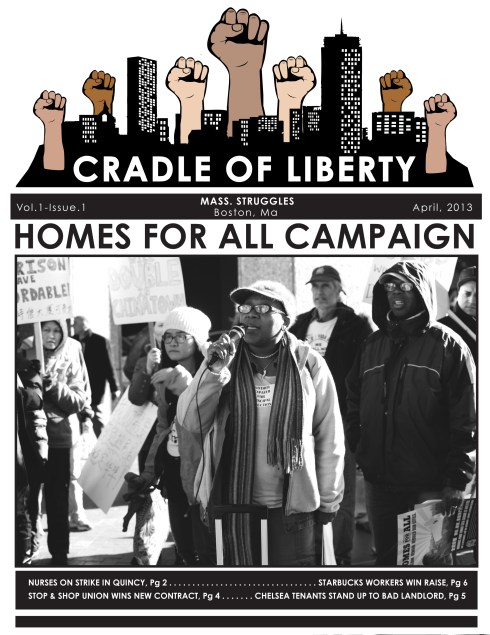
(Click on the Cover Photo to read or download!)

Inside Issue #1

Mass Nurses Vote to Strike

Massachusetts Foreclosed Homeowner Raises Protest in D.C.

Stop and Shop Signs Contract with Union Workers

Chelsea Tenants Stand up to City Realty

Nationwide Homes for All Campaign Launched

Starbucks Workers Win Raise, But Victory is not Total

Interview With a Barista

The BU Biolab, A Continuing History of at Risk Neighborhoods