Our band will be playing with a handful of folk and punk bands tomorrow night in Allston.
Glad to support the IWW and the garment workers of Bangladesh. Come join us!

Please join members of the Industrial Workers of the World at a Benefit Concert
 for Bangladeshi workers and their families. The show will take place on Sunday,
 January 19, starting at 8 pm, at O'Brien's Pub in Allston, at 3 Harvard Ave.
The concert will feature original punk music performed by IWW members.
All proceeds will benefit the education fund for children of workers killed in
the Tazreen fire and Rana Plaza factory collapse (the fund is a project of the
Bangladesh Workers' Solidarity Network.
Archive | Uncategorized RSS feed for this section
Jake and the Infernal Machine plays tomorrow
18 Jan
Image
Presenting my Book in Central Square, Cambridge!
16 Jan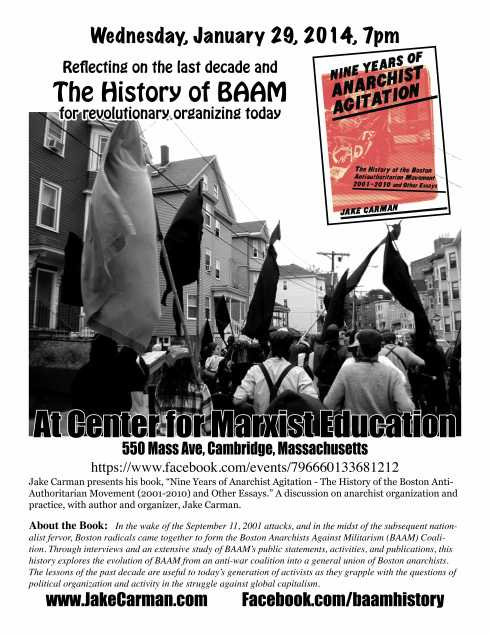
Hey friends,
It’s been a while since I’ve posted. It’s also been a while since I spoke about my book. Come out to Central Square!
Jake Carman Presents his Book: “Nine years of Anarchist Agitation: The History of the BAAM and Other Essays”
Wednesday, January 29, 2014, 7pm
Reflecting on the last decade and the History of BAAM
for revolutionary organizing today
At Center for Marxist Education
550 Mass Ave, Cambridge, Massachusetts
https://www.facebook.com/events/796660133681212
Jake Carman presents his book, “Nine Years of Anarchist Agitation – The History of the Boston Anti-Authoritarian Movement (2001-2010) and Other Essays.” A discussion on anarchist organization and practice, with author and organizer, Jake Carman.
About the Book: In the wake of the September 11, 2001 attacks, and in the midst of the subsequent nationalist fervor, Boston radicals came together to form the Boston Anarchists Against Militarism (BAAM) Coalition. Through interviews and an extensive study of BAAM’s public statements, activities, and publications, this history explores the evolution of BAAM from an anti-war coalition into a general union of Boston anarchists. The lessons of the past decade are useful to today’s generation of activists as they grapple with the questions of political organization and activity in the struggle against global capitalism.
http://www.JakeCarman.com Facebook.com/baamhistory
Service Workers Forum tomorrow!
10 DecHey all,
I’m helping to plan this event below for tomorrow night with some comrades at BU Student Labor Action Project and the IWW. It should be awesome, please come check it out if you’re in town!
-Jake
Resistance with Dignity! Service and Low Income Workers’ Forum
7pm, Wednesday, December 11th,
At Boston University, in the College of Arts and Sciences room 201.
685 Commonwealth Avenue, Boston, MA.
https://www.facebook.com/events/180152515517277/?context=create#
Since the onset of the Great Recession in 2008, the cost of living has risen and corporate profits increased, while minimum wage and other industry standards for low-wage workers have remained the same. Even worse, many employers use the recession to demand concessions and rollbacks from their workers.
Yet across the Boston area, workers in a variety of industries are fighting back. From hotels to restaurants, workers are organizing to demand pay increases, benefits, and union recognition. Come hear from workers struggling in these industries as they share their stories. Participate in a discussion with us about union organizing and shop-floor struggles.
Speakers:
Rosa de la Rosa – Le Meridien Hotel
Tasia Edmonds – Insomnia Cookies, BU
Cris Barros – Mass. Uniting (Former KFC worker)
Jonathan Peña – Insomnia Cookies, Harvard
Hosted by the Boston University Student Labor Action Project and the Boston Industrial Workers of the World
https://www.facebook.com/events/180152515517277/?context=create#
Review of “Nine Years of Anarchist Agitation”
28 OctHere’s a review of my book, Nine Years of Anarchist Agitation: The History of the Boston Antiauthoritarian Movement and Other Essays (2012), written by British writer Kevin Eady, author of an e-book entitled Uncontrollable, the autobiography of a fictional 101-year-old Spanish anarchist, which you can parchase here: Uncontrollable.
Nine Years of Anarchist Agitation – The History of the Boston Antiauthoritarian Movement.
by Jake Carman.
A Review by Kevin Eady
This was an interesting read. For a European (British) reader this document lifted the lid on contemporary American anarchism in a most revealing way. European leftists tend to view America as the Great Satan and focus on the seemingly overwhelming right-wing political culture of that country’s leaders, generals and opinion-formers. What we miss out on are the undercurrents of radical thought and action which have never ceased to flow below the surface. Socialism, communism, feminism, black radicalism, anarchism and other anti-establishment movements have always been present, even if the numbers of adherents have remained few and fluctuating.
The History of BAAM helps to show why anarchism, in particular, remains such a minority movement, whilst at the same time commanding much sympathy from segments of the population. We are shown examples of BAAM educational leaflets, linking current-day struggles with historical ones in Spain and Russia, and with modern-day movements in Mexico and Greece. We are given instances of BAAM’s involvement in local and industrial conflicts at home and of BAAM’s participation in anti-war, anti-capitalist and ecological demonstrations and protests.
The author also honestly presents us with the truth about organisational in-fighting and dissent, a problem which has beset many anarchist movements in other parts of the globe and at other times. It almost seems that many of us are more willing to waste our time arguing about the minutiae rather than get stuck in to challenging the monstrous forces of the state and capital which control large aspects of our lives. It’s easy to spend a lot of time debating strategy behind closed doors whilst the rest of the world gets on with its life outside.
What impresses me as an outsider about BAAM is the bravery of those who participated in its actions, and the photographs help demonstrate this remarkably. Although few in number and at times subject to violence and intimidation from the authorities, there was never any attempt to hide their allegiance to anarchism – instead a pride in independence of thought and an awareness of continuance of a historical tradition are more than manifest. This reminds me somewhat of the Provo movement in Amsterdam in the mid-1960’s. Small numbers of committed individuals, for a time, can galvanise wider sections of society into taking action and confronting the powers that be.
Sadly, like Provo, nothing lasts forever. BAAM is no more, but it must still leave a legacy in the minds of the many hundreds and thousands who took part in its activity, read its leaflets and witnessed its presence on the streets. Whether anything more will result from all of that only time will tell and it would be easy for BAAM activists to lose heart and become inactive. What we all have to remember is that all of our actions have an impact. We may be a million miles away from achieving our goals, but our immediate realities may have inched forwards, our confidence in ourselves may grow every time we confront authority and the minds of our fellow citizens may have begun to question just that little bit more.
This document is clearly written and easy to read. I am not quite sure who its intended readership will be, other than future historians of minority movements and present-day enquirers into the problems and opportunities for non-hierarchical politics. It is certainly not a polemical piece, nor one intended to convert anyone to anarchist perspectives. Personally I found some of the more interesting parts to be those concerning Greece and Mexico, both countries where anarchistic movements have acquired some mass membership and support, rather than activities carried out in Boston itself. But, all in all, a book well worth reading. If the anarchist movement in my part of the world ever got anywhere near as interesting, articulate and effectual as BAAM then I would explode with enthusiasm.
Strikers Deliver Demands to Insomnia Cookies; Company Targets Union Member
27 Oct(Article first appeared at CradleofLibertyNews.org. For photos, check iwwboston.org)
Strikers Deliver Demands to Insomnia Cookies; Company Targets Union Member
By Jake Carman
On Thursday, October 24th, striking workers delivered a demand letter to the Harvard Square location of Insomnia Cookies. Niko Stapczynski and Jonathan Peña—who were fired after declaring a strike with two other employees on August 18th—and fifty members of their union, the Industrial Workers of the World (IWW), visited the late-night cookie chain at 10 P.M. In their letter to management, the workers demanded reinstatement with back pay, compensation for nearly $1000 in short paychecks and withheld lunch breaks, company neutrality to the union and a card check election, and an end to the practice of forcing employees to sign a non-disclosure agreement. The union is threatening to turn these demands into legal charges if Insomnia fails to respond within two weeks.
Also on October 24th, Insomnia baker Tommy Mendes, who still works at the Harvard Square Insomnia location, declared to management that he, too, had joined the IWW. Mendes sent an email to his boss, simply stating “I just wanted to let you know that I’m a member of the Industrial Workers of the World.” While Mendes joined the IWW soon after his coworkers began their strike, according to the union, he only recently “made the courageous decision to go public and has announced his union affiliation to his manager…in part due to intolerable pressure and threats on the job.” The company suspended Mendes immediately, and the union promises to fight what they call “unlawful retaliation for his union activity.”
The public struggle at Insomnia Cookies in Harvard Square began at midnight on August 18, when the entire four-person night shift voted to initiate a strike for higher wages, healthcare, and freedom to form a union. Peña, Mendes, and coworkers Chris Helali and Luke Robinson—who have since moved out of state—closed the shop, contacted the IWW, and began holding pickets and building connections with Harvard and BU student organizations. Pickets have since spread to the new Boston University store.
Workers claim Insomnia has a bad track record when it comes to following labor laws and fairly compensating their employees. According to the demand letter, “For months prior to the strike, workers employed as ‘drivers,’ had not received minimum wage. Also, employees often did not receive the 30 minute meal break for shifts longer than 6 hours, to which they are entitled by MA State Law.” Drivers, who deliver cookies by bicycle until 3 A.M., and rely on tips to pad their $5 and hour wage, complain the company has unrealistic expectations of delivery times, and pressure from management causes unsafe riding and accidents. Whats worse, according to the union, “Insomnia does not give paid time off when drivers get hurt on the job, and instead blame them for the accidents.” The company doesn’t offer health benefits to the workers either.
Before the strike, the average turnover rate for a local Insomnia employee was only three weeks. The droves of Boston-area Insomnia workers who have recently quit the job, as well as the firing of the company’s regional manager—in part due to his inability to keep his stores staffed and functioning—attest to the aptly-named Insomnia work environment. Insomnia, which has 33 locations on college campuses across the US, sustains itself only by exploiting students two-fold: as employees, where they are underpaid, barely trained, easily-replaceable, and overworked, and also as consumers, where they are sold frozen cookies at unjustifiably high prices. In order to hold Insomnia accountable and to end the company’s reprehensible labor practices, IWW members are encouraging workers nationally to join the union, and if they are planning to quit already, to go on strike.
Ways to Get Involved:
-Dont Quit, Strike! http://iwwboston.files.wordpress.com/2013/10/dont-quit-strike.jpg
-Donate to the Insomnia Strike Fund:
https://www.wepay.com/donations/insomnia-cookies-workers-strike-fund
-Sign the petition to support the strikers’ demands:
https://docs.google.com/forms/d/1TLCetxHNxmGHk57FD1Sy9KAtUNHXP5alQWrgxPcb-Lk/viewform
-Find us Online: https://www.facebook.com/insomniaunion http://iwwboston.org/
To reach the Boston IWW:
Email: iww.boston@riseup.net
Phone Number: 617-863-7920
Mailing Address: PO Box 391724
Cambridge, MA 02139
Facebook: http://www.facebook.com/BostonIWW/
Image
“The Peasants’ Revenge” – Painting, Oil on Canvas, Oct 2013. For the Ocassion of N. Makhno’s 125 Birthday
26 Oct
A new painting! I’ve been working on this one for over a year, and finished it just in time for Nestor Makhno’s 125th birthday (today). Here are two articles from the BAAM Newsletter, reedited for my book, about Nestor Makhno and the Ukrainian Peasant anarchists (the subject matter of my painting). I hope to get a better photo of this, anyone out there with a good camera and some time?
Click here to check out details of the painting!
Happy Birthday Nestor Makhno: You are not Forgotten
The Boston Anti-Authoritarian Movement Newsletter, Issue # 3 – October 2007
Nestor Ivonavich Makhno, peasant leader of the 1917-1921 Ukrainian anarchist revolution, was born on October 26, 1888, 119 years ago this month. Makhno was, as Alexander Berkman wrote in his essay, Nestor Makhno, the Man who Saved the Bolsheviki, a “[t]rue child of a revolutionary epoch…it is more than probable that but for him and his insurgent army of Ukrainian peasants Soviet Russia might now be only a memory.”
Born to a poor peasant family in 1888, Makhno joined the anarchists early and at the age of seventeen, he found himself condemned to death for revolutionary activities. Because of his youth, his sentence was commuted to life imprisonment at a notorious Moscow prison. There he stayed, reading and fighting off tuberculosis, until the February Revolution freed him. Makhno immediately returned to his hometown of Guylia-Pole and raised a peasant army to resist a Prussian invasion of the Ukraine. His enthusiasm and dedication quickly gained him mass support. His devilish military cunning helped rid the Ukraine of the Prussians, and the peasants and workers launched an anarchist social revolution. As Berkman writes, “He had organized communes…and a large part of the Ukraine, covering hundreds of miles, with millions of population, live a free life and refuse to submit to the domination of any political party.”
In 1918, Makhno’s 25,000-strong insurgent army joined with the Bolshevik Red Army and succeeded in routing the reactionary White Army. The insurgents even saved Moscow from a White Army offensive in 1919. Immediately after this victory, Leon Trotsky—general of the Red Army—and the Bolsheviks capitalized on a widespread disease that had put Makhno in a coma and infected much of the insurgent army. When Makhno awoke some weeks later, the Red Army had occupied much of the Ukraine, outlawed Makhno, destroyed the soviets (workers’ councils) for not submitting to Bolshevik authority, and arrested and executed many insurgents.
Makhno jumped from his sick bed and hastened to rebuild his forces to take the fight to both the Reds and the Whites. He rode into battle, as Berkman describes, “Invariably at the head of his light cavalry…[h]e was reputed never to have lost a battle and never to have been wounded, though his favorite method was hand-to-hand combat with a sword or sabor.” In very little time, using creativity and the element of surprise, as well as convincing whole units of the enemy’s armies to join the insurgents, Makhno’s Black Army had succeeded in liberating Guylia-Pole and a large portion of the Ukraine.
In the absence of the insurgent army to resist them, the White Army had fought back to Moscow’s doorstep. Trotsky again begged Makhno for aid, and the anarchists agreed on the condition that anarchist prisoners be freed and the Ukraine granted autonomy. The Makhnovtchina again saved the Bolsheviki from certain defeat, and Trotsky invited the anarchist leaders to a celebration. It was a trap: Makhno was shot off his horse upon arrival and many of the anarchists were arrested or killed. When Makhno and a few others made it back to the Ukraine, they found it occupied by 150,000 Red Army soldiers who were no longer worried about the defeated Whites. The Ukrainian anarchists fought every day for almost a year, constantly surrounded on all sides and vastly outnumbered. Makhno realized his cause was lost and that the fighting was only destroying the Ukraine. He fled in 1921 and finally settled in Paris in 1925.
Makhno lived on, heartbroken and forgotten, hated by many of his comrades who believed the Bolshevik myths about the Ukrainian Revolution. He died in 1934 from tuberculosis. The Bolsheviks tried to eradicate the memory of Makhno and the anarchist social revolution, but they have failed. He will live on and inspire revolutions to come, and encourage rebel leaders to lead by example, from the front of the charge, as he did.
Walking, We Make the Road: An Account of the Crossroads of Ukraine and Spain’s Anarchist Revolutions
The Boston Anti-Authoritarian Movement Newsletter, Issue # 2 – September 2007
In Paris, in August 1927, while Sacco and Vanzetti were waiting to die here in Boston, Buenaventura Durruti and Francisco Ascaso—Spanish rebels who would later play a vital role in Spain’s anarchist revolution (1936)—met with Nester Makhno, the exiled leader of the failed anarchist revolution of the Ukraine (1918). Durruti and Ascaso were on the run, wanted by the governments of Spain, Cuba, Mexico, Argentina, and several other Latin American countries for stealing from the rich to fund revolutionary workers’ unions, papers, and schools. Still in their early thirties, Durruti and Ascaso were men of action, full of energy and life. They stood on the threshold of a revolution they had spent the previous decade agitating for.
Makhno, though only thirty-eight, was by then already a ghost of his former self. He was battered and burnt out from his years of leading from the frontline through the Ukrainian Revolution and Russian Civil War. In 1918, he helped build an army of 25,000 anarchist peasants and workers. Makhno soon proved to be a brilliant, daring, and creative military leader, as well as a visionary. While successfully fending off German invaders, Ukrainian nationalists, and White Army reactionaries, the anarchists inspired a vast social revolution based around communes and soviets (the Russian word for workers’ councils). The people claimed the land of the rich and the bosses, facilitated free exchange and solidarity between rural peasants and city workers, and worked to implement anarchist communism.
These Ukranian worker and peasant soviets differed from the Bolshevik soviets. They were not ruled by the Bolshevik Party, nor any other party. Instead, they were organized through democratic assemblies.
The Bolsheviks couldn’t stomach this example of soviets based on freedom and equality. Lenin and Trotsky, breaking a pact of alliance with the Makhnovtchina, sent 150,000 red soldiers to assert their control over the Ukrainian soviets. Makhno and his comrades were forced to fight both the Red and White armies simultaneously. The anarchist peasants proved themselves formidable warriors in this endeavor, but once the White Army was thoroughly defeated, the Kremlin was able to commit the bulk of the Red Army to crush the Ukrainian anarchists.
In 1921, the anarchists were finally overwhelmed. Makhno decided to flee rather than continue a futile war that was ravaging his country. He ended up in Paris in 1925, where he lived a tormented existence plagued by tuberculosis and battle wounds.
Makhno was undoubtedly relieved to find kindred spirits in Durruti and Ascaso, and honored when they told him of the Ukrainian Revolution’s influence on the Spanish anarchist movement. Standing on the other side of the revolutionary experience, Makhno gave Durruti and Ascaso invaluable advice for their own struggle. Even today, we should consider his words.
According to an account of this meeting in Abel Paz’s Durruti in the Spanish Revolution, Makhno told the Spaniards, “You have a sense of organization in Spain that our movement lacked; Organization is the foundation of the revolution….But,” he warned, “You have to work hard to preserve that sense of organization, and don’t let those who think anarchism is a theory closed to life destroy it. Anarchism is neither sectarian nor dogmatic. It is a theory of action. It doesn’t have a predetermined world-view….It’s a force in the march of history itself: the force that pushes it forward.”
Makhno, Ascaso, and Durruti believed in an anarchism of action, but they were not exclusively insurrectionaries. They understood that the ideas, needs, and efforts of the people must genuinely be the moving force behind the revolution. Fighting is but only one part. Makhno told the Spaniards that in the Ukrainian communes, it was “the revolutionary participation and enthusiasm of everyone, which made sure that a new bureaucracy didn’t emerge. We were all fighters and workers at the same time. In the communes, the assembly was the body that resolved problems and, in military affairs, it was the war committee, in which all the units were represented. What was most important to us was that everyone shared in the collective work: that was the way to stop a ruling caste from monopolizing power. That’s how we united theory and practice.”
Durruti and Ascaso, like Makhno, were toilers by trade. All three desired and fought for what amounted in both cases to a short attainment of successful and practical anarchist communism involving millions of people. However, they were successful because they first participated in the organizations of the masses, be they the peasant organizations of the Ukraine, or the syndicalist unions of Spain. They participated in these not to demand ideological purity of the masses, but to empower the millions of working and oppressed people to raise their voices and ideas, and to struggle for their collective liberation. Without these efforts, the anarchists never would have succeeded in building the popular movements that gave birth to two great anarchist revolutions that still inspire us.
The same applies today, eighty years later. We anarchists hold many different ideas, but anarchism is not the realization of one idea held by a political minority: it is the collection of the ideas and actions of a whole people, striving to solve the problems of society. So let’s join together, put aside sectarian infighting, and get to work within the existing social organizations of the people, as did Makhno, Durruti, and Ascaso. Let’s not let those for whom anarchism is a dead theory, a collection of old books, or a single, decided ideology, derail our efforts for a united popular movement for the liberation of all, with the theoretical input by all. Through our work within popular struggles, we anarchists can help bring cohesion through solidarity, and prove the worth of our ideas by our efforts. As Francisco Ascaso used to say, “Walking, we make the road.”
Paz, Able. Durruti in the Spanish Revolution. AK P, 2007.
Skirda, Alexandre. Nestor Makhno: Anarchy’s Cossak, the Struggle for Free Soviets in the Ukraine, 1917-1921. AK P, 2004.
“The Peasants’ Revenge” Oil on Canvas, Oct 2013, Details
25 Oct“The Peasants’ Revenge” Oil on Canvas, Oct 2013, Details
Painting by Jake Carman
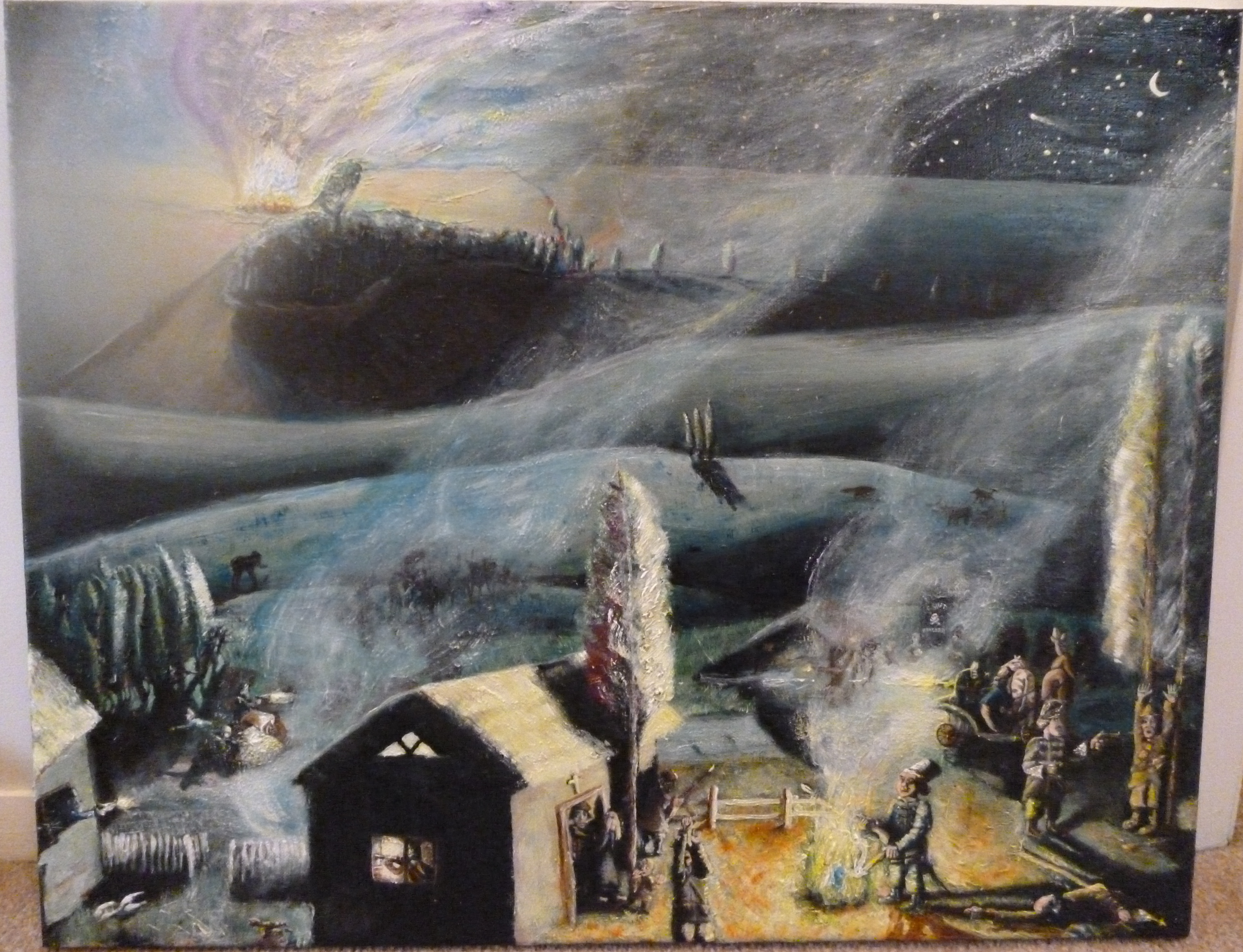 Full Painting
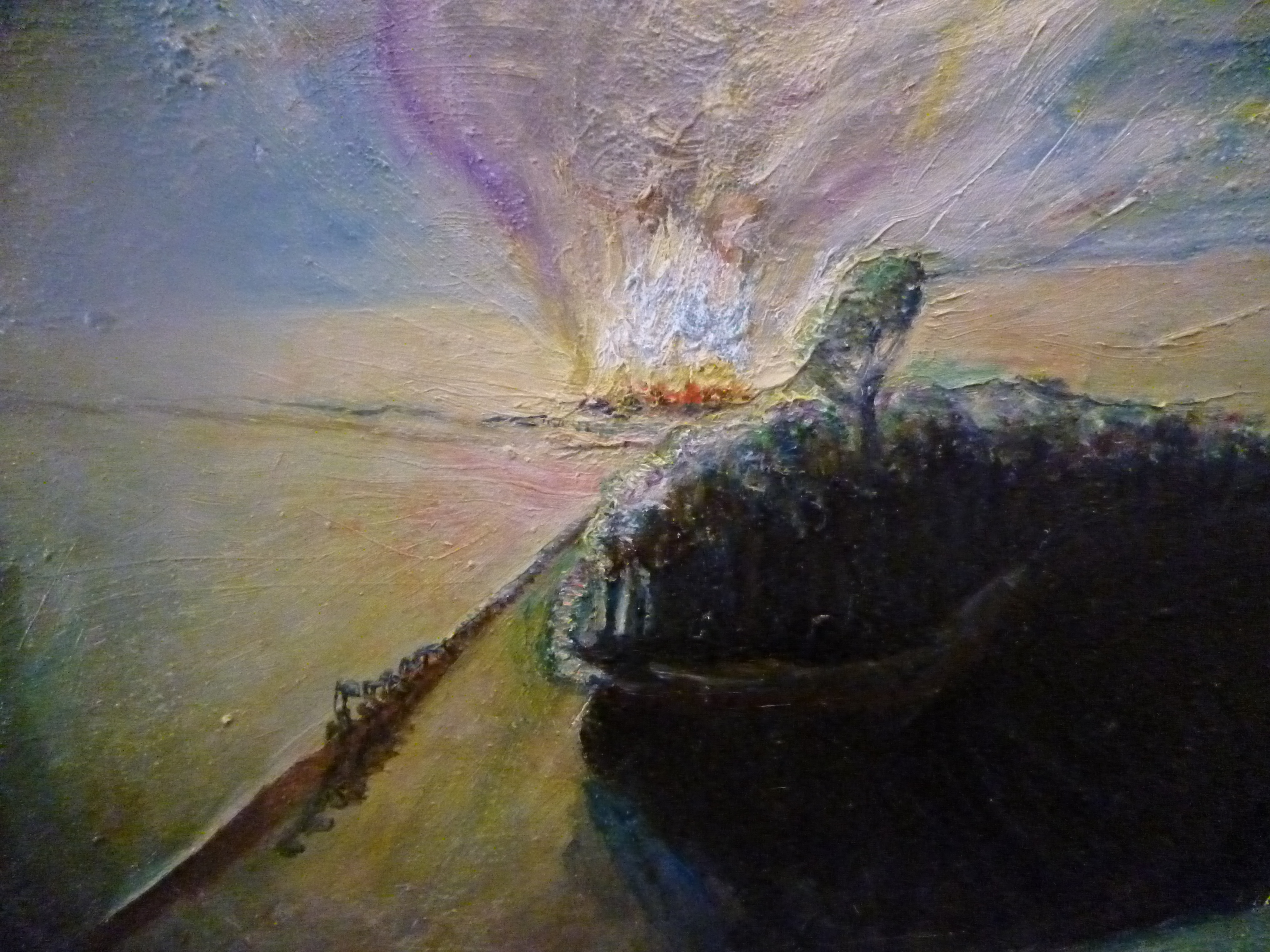 Top-left Corner – Fire at Dibrivki
 Bottom-right corner – Makhno and Schauss
“Nine Years” Now Available on Bookshare
7 OctMy book is now accessible to the to the visually impaired and people with other print disabilities.
Nine Years of Anarchist Agitation: The History of the Boston Anti-Authoritarian Movement and Other Essays, by Jake Carman, is now hosted on Bookshare at: https://www.bookshare.org/browse/book/686705
Bookshare is an affordable digital library run by a non-profit, according to their website, “to raise the floor of access so that people with print disabilities can obtain a broad spectrum of print materials at the same time as everyone else.”
Please share this link with people you know who might be interested.
Prison Action News! Issue 6.2!
3 OctHey friends,
My partner and I work on an incredible publication called Prison Action News, which is made up entirely of prisoner writings on the struggles behind bars. We send thousands of copies into prisons across the US, and you can read the PDF here: Internet Version PDF
Also, if you have friends in prison, please print out a copy and send it to them! Print Version PDF
Lastly, for more about Prison Action News, check out the website of the Boston Anarchist Black Cross
Reading Group on Fast Food Strikes: Saturday September 21st: 6-8 PM
12 SepHello friends and comrades,
The article I posted here yesterday will be among three articles discussed at an upcoming reading group in Boston. Check it out, it looks like it will be a good and timely discussion.
Common Struggle Reading Group – Fast Food Workers, Recent Strikes, and “Alternative” Labor
-Saturday September 21st: 6-8 PM reading group at Community Church of Boston, 565 Boylston St, Boston, MA, 02116, in Copley Square.
This summer, fast food workers across the country have launched strikes and pushed for unions and better jobs. SEIU has played a large role in this movement, utilizing a “new” or “alternative” labor model, supporting smaller, independent workers’ initiatives, organizing symbolic strikes, and pushing for a higher national minimum wage. Locally, workers at Insomnia Cookies recently launched a strike and joined the Industrial Workers of the World.
Join us to discuss the strategies of and relationships between “Alt” labor, industrial and direct-action unionism, and the growing movement of fast food workers, with three short readings to guide our discussion.
Readings:
1. Fast food strikes to massively expand: “They’re thinking much bigger” By Josh Eidelson.
http://www.salon.com/2013/08/14/fast_food_strikes_massively_expanding_th…
2. Venture Syndicalism: Fanning and dousing the flames of discontent. By Nate Hawthorne.
http://libcom.org/blog/venture-syndicalism-fanning-dousing-flames-discon…
3. Striking Workers at Insomnia Cookies Join the IWW. By Jake Carman.
http://iwwboston.org/2013/09/11/striking-workers-at-insomnia-cookies-joi…
-Optional supplemental reading:
1. Upper Crust Pizzeria To Reopen as ‘The Just Crust.’ By Nikki D. Erlick,
http://www.thecrimson.com/article/2013/1/23/upper-crust-reopening/
Sponsored by Common Struggle-Libertarian Communist Federation:
www.CommonStruggle.org
Nine Years of Anarchist Agitation: The History of BAAM (2001-2010) and Other Essays

Cradle of Liberty News

A New Publication of Mass. Struggles
 Jake Carman
